Bitmap Books

Showing posts with label Fighting Games. Show all posts

Monday, 28 November 2022

Neo Geo Pocket Color Selection Volume 2 Review (Switch)

Like the first Neo Geo Pocket Collection, Volume 2 brings another ten games to the Switch (Eleven if you count both versions of SNK VS. Capcom Card Fighters’ Clash). It means that around a quarter of all the games available on the system are now on Nintendo’s hybrid and we can only hope this continues. It also helps that there’s some really good games on here.

Like the first volume this collection brings together the individually released Pocket games from the year, compiles them and adds a host of others as well. We’ve had fewer individual releases this time around so it’s an enticing prospect even if you’ve already broken cover and purchased some of the games already.

Included are three sports games. Neogeo Cup 98 is an easily forgettable football game but the other two fare far better. Pocket Tennis is great and evokes memories of Super Tennis back on the SNES. We found ourselves losing far more time than we intended, and it works great for quick goes. Baseball Stars is also a lot of fun with each of the teams having unique stats and each area of the game being represented well. Both may not have warranted individual releases, but they are far more than just filler here.

There are two quirky games on here as well with The King of Fighters Battle De Paradise providing a sort of weird board game version of the game and the notoriously quirky Ganbare Neo Poke-Kun also here. Unfortunately, both games are in Japanese (though the manuals have been translated). Both games are confusing enough without having to fight through a foreign language as well. Ganbare in particular has a fair amount of text so you’ll need to keep going back an forth to know what is going on. The game itself has a weird creature developing mini games which you can then play, and you have to effect his environment to keep him awake. Yes, it’s very strange.

Biomotor Unitron adds a much-welcomed RPG to the collection though in truth it’s quite average. It’s a bit Pokémon like but instead of creatures you are collecting resources for your robot. It’s solid but we can’t see many people seeing it through to the end. The previously released Mega Man Battle and Fighters is also included, (and not translated from Japanese), which provides two games which are effectively a succession of boss battles in a kind of basic fighting game. It’s fun, but nothing amazing and without the license would likely be forgotten.

What is a wonderful surprise is Puzzle Link 2. On the surface it seems like a sort of Magical Drop or Puzzle Bobble clone but that is not the case. You do have to match colours, but you do this by connecting them with pipes that you throw up the screen. It’s a fresh and clever take on the genre and one you’ll lose a lot of time to. Who knew Pipemania crossed with Magical Drop was the game we all needed?

The remaining two games have both been released separately. Big Bang Pro Wrestling has proved to be a really nice surprise. We had never even heard of it but it’s now up there with SNK vs Capcom: Card Fighters Clash as our most played NGP game. It plays well, it’s inventive, the graphics and sound are satisfying, and it uses the control scheme the best you can possibly expect for the system. There’s also a wide range of characters and match types to pick from.

SNK Vs, Capcom Card Fighters’ Clash is of course the headline act here with both versions of the games included and the English and Japanese language versions of both those games as well. The card battles themselves are deceptively complex. Battles play on out on a table where players can lay a maximum of three cards down. When played, cards add whatever special points they have to the players total and also present a battle point value to attack and defend with. The special points then allow for things like dual attacking and launching special abilities. Once cards are down players can either attack with them or hold them back to defend. Once an action has been taken the card in question is then frozen. This is important as you must weigh up how likely you are to be able to defend against incoming attacks and if an all-out strike by your team is worth leaving yourself defenceless for.

The key here is that you aren’t trying to eliminate all your opponent’s cards but instead knock down their health bar. If they are unable to block an incoming attack with a card the battle points value of the card will be removed from their total. Once it reaches zero, they lose. The same goes for you of course, so the balance between attack and defence is key. The only frustrating thing here is of course that there is always a certain random element to how cards come out so some games can be lost very early on with little the player can do about it. Of course, when you get hold of a few better cards to add into your deck this also works the other way as you can destroy your opponent very quickly if they start with a bad hand.

Overall, this second volume of Neo Pocket games has been put together very well. There’s enough here to warrant buying the whole package if you’ve already bought one or two of the other games and there is a good mix of different styles and genres. It also shows the handheld was far more than just mini versions of 2D fighters. If haven’t bought Card Fighters’ separately already this is pretty essential, and even if you have the other games are well worth playing. Let’s hope more collections appear in the future.

Overall 8/10


Monday, 1 March 2021

SNK VS. Capcom: The Match of the Millennium Review (Switch)

SNK has been releasing a number of its chibi styled Neo-Geo Pocket fighters on Switch but this is the first time the company has ventured into its crossover relations with Capcom. The home console versions of Capcom VS. SNK 1 and 2 are both much loved and would surely garner a lot of interest were they to reappear. With that in mind this release is a tantalising hook for fans hoping it may lead to companies working together again in the future.

As adaptations to handheld consoles go this is pretty impressive. There are a ton of characters to pick from and the tag and team based modes also make the cut. The single player mode even has story scenes and plot to it and there are extra modes present such as survival, time attack and a host of mini games. In terms of options you’ve got them in abundance as well with a full suite of display and control configurations to play with.

The game also looks massively impressive with iconic stages from various SNK and Capcom fighters shrunk down and recreated in the distinct visual style. The music is also recreated to the best of the systems capabilities and fighters are easily distinguishable in their more pocket style. In terms of presentation there is little to fault here and many will be charmed enough by this alone to justify the purchase. It really does look lovely.

The biggest issue comes with how the game actually plays. With only two buttons to work with the move sets have obviously been adapted. It actually works out quite well and still offers a range of punches, kicks and special moves of varying strengths. The main problem here though is the input for the special moves. The original hardware never made this the easiest thing to do but trying to pull off chibi fireballs and dragon punches using the Switch controls is a whole new level of inaccuracy. Thankfully using a pro controller works better but using a pro controller for a portable port of a portable console game is not really ideal.

Though it can be frustrating, the game still works well enough to be knock about fun. It has a good pace to it and will certainly provide an enjoyable distraction. Chances of players sticking with it long term though are fairly unlikely. There just isn’t enough depth here and the moves are just a touch too annoying to pull off to make this a regular go to when other fighters are available and much friendlier on the hands.

Overall, SNK VS. Capcom is an enjoyable game and one that fans of the genre and retro collectors will certainly have some fun playing around with in short bursts. The added weight of the license attached to it makes it the most likely of the Neo Geo Pocket games to catch peoples eye and we are very glad that SNK’s portable console is getting a new life for a new audience. The care and attention the port has had put into it is also commendable.

The truth is that the market for this version of the game (or any of the Neo Geo Pocket Fighters), is somewhat niche. With games such as BlazeBlue, the numerous ACA games and the Street Fighter Anthology it’s hard to see anyone coming out with this as their favourite fighter. It’s like playing Killer Instinct on the Gameboy – Yes, it may be very impressive but given the option you’ll always go for the bigger brother.

Overall 7/10

Monday, 15 February 2021

Nintendo Switch Retro Roundup 4: ACA Neo Geo Fighters


There’s a whole host of arcade and fighting games now available on the Switch. As a long-time fan of the genre here are our personal picks of the host of Neo Geo ones available.

World Heroes 2

Though a fairly simplistic fighter, World Heroes 2 does have a lot going for it. One of the things that set it apart is the expansive and colourful cast of characters based on historical figures. What other fighting game allows you to pit Hulk Hogan and Bruce Lee look-a-likes against Joan of Arc?

The standard two round mode only acts to show up the games shortcomings. Select the Death Match mode however, and things suddenly become a whole lot more interesting. Here two fighters battle over a single energy bar during one extended round. The best aspect of the Death Match is the obstacle filled levels you fight in. Some stages have metal blades running along the floors, while others are strewn with landmines or take place in a small metal cage.

World Heroes 2 may not be the most technical game, but once you switch it into the Death match mode it can still offer something to fight fans today. If you want to try a game that's a little different then hunt it out


Samurai Shodown 2

For many this mix of martial arts and swords is SNK's finest hour. Here at Retro 101 we don't hold it in such a high regard, but we do still love it to pieces. The Samurai Showdown series is one of the most unique fighters out there and this second iteration is one of the finest fighting games available.

In this sequel more characters were added, along with the POW finishing moves. More importantly, the game was fine-tuned and balanced to be much more even than the first. What we end up with is a tense series of bouts where any wrong move could be your last.

Fitting for a series concerned with weapon combat, the basic gameplay requires quick strikes when an opening presents itself, rather than long combo sequences. This can seem tough for newcomers as three or four strong blows can end a round. For those that learn the ways of the sword though it soon becomes clear that Samurai Showdown is as much about knowing when not to strike as it is about attacking.

A host of Samurai Shodown titles are available on the Switch and there is also a collection which includes the final version of Samurai Shodown V Perfect for the first time. The newest title in the series is also available and holds up fairly well on Nintendo’s machine.


The Last Blade/The Last Blade 2

This often overlooked other weapon based fighter is, in our opinion, the best of SNK's 2D fighting games. While Samurai Showdown III and IV ended up fun but uneven these two games are a lesson in balanced combat where mastering your character is the key to victory.

Each character is different and all have their own strengths and weaknesses. They can also be customised by picking different attack forms. The first game lets you make your fighter either speed or power based, while The Last Blade 2 adds an EX option as well.

The difference between the three styles makes a remarkable impact on your strategy. It also looks beautiful and each new area is presented with a subtle cut scene beforehand to add atmosphere. The special moves are not massively flashy but it all keeps with the games ethos of balance and skill. Everything about the title(s) leaves you with the impression you have just played something destined to be a classic.


Garou: Mark of the Wolves

This re-imagining of SNK's long running Fatal Fury series was developed to provide competition to Capcom's Street Fighter 3. Perhaps surprisingly, it almost manages to match Ryu and friends. The action is fast, tense and fluid and each of the characters has a real personality of their own.

Mark of the Wolves is a distillation of all the good points of the Fatal Fury series over the years and also throws in some wonderful tactical features. For instance, blocking at exactly the right time creates the chance to parry your opponent's attacks for big damage. Also, a new T.O.P bar is placed on your characters health meter. When you drop into the bar it allows for a new technique to be used.

As a reinvention of a franchise it is hard to think how a better job could have been done. From a slightly ageing and creaky bunch of titles a vibrant, skill based and flair filled fighter has emerged that really does deserve all the credit it gets


The King of the Fighters 

The proverbial SNK team based cash cow. Ever since the first title way back in 1994 a new game has appeared almost yearly. While none of the games are bad, the real cream of the crop appeared between 1996 and 2000. After that, the focus seemed to be more on making things look flashy in 3D, though King of the Fighters XIII is excellent. Our personal favourite is the 1998 entry.

For those that don't know, the King of the Fighters titles allow you to pick a team of SNK's finest from various games and take on other teams. When one player is knocked out the next in line joins the battle. Certain versions of the game also introduce a fourth striker character that can be called upon to use a sneaky special move a limited number of times.

Considering the amount of fighters on offer the game remains remarkably balanced. It also requires players to learn many more moves and strategies than they would normally as you need to be handy with a number of different characters to succeed. A few minor balancing issues aside the series always remains fun and highly enjoyable.


Real Bout Fatal Fury

All three of the Real Bout games are available on the Switch. Each adds and refines elements but it’s the first game that we find ourselves returning to. The reason for this is simple that in the first game at the edge of each screen are breakable barriers. Once destroyed opponents can be through from the stage causing an instant ring out. It may not sound like much but ducking an opponent’s charge only to see them going flying off a pier into the sea rarely gets dull. 

The series is often forgotten when talking about Fatal Fury so it’s nice to see it well represented. It’s also one of the only places you can play Real Bout 2 as it never made it to home consoles originally.


Waku Waku 7

Waku Waku 7 is one of the weirdest and most wonderful games we have ever come across. The game itself is a polished title from sunsoft that bases itself on the classic SNK four button template. What sets it apart is the mad cast of characters and super bright colour scheme. This title, you see, is a completely crazy parody of Japanese anime.

The bizarre combatants include a giant Totoro style Japanese soft toy creature and a walking tank with a gun for a head. The moves are over the top and it all rolls along at a lively pace. It's unlikely that Waku Waku 7 will hold players attention for as long as something like Street Fighter Alpha 3 but it is undeniable fun and anarchic. Waku Waku 7 is pretty difficult to find so having it available on the Switch is great.

Monday, 5 October 2015

Arcana Heart 3: love Max!!!! Review (PC)


The Arcana Heart series has been largely ignored by western audiences over the years. Even the first version of Arcana Heart 3 did little to make an impact on the established brands of Street fighter and BlazBlue. Arcana Heart 3: Love Max!!!! has taken the 2011 version of the game and reworked it to try and build on a solid template and make one more attempt to hit the sweet spot for fight game fans.

The unique selling point of the series is that it contains an all-girl cast. Don’t worry though, this isn’t one of the highly questionable Japanese titles that are borderline pornographic. Characters here are for the most part treated in a much better way than female characters can sometimes be. The other key gimmick is that the base characters can be combined with a large range of magical ‘Arcana’ spirits to give staggering depth and flexibility in how you want fight.

Arcanas are basically huge magical beings that give extra powers, attack and defence options (Think of them like the summon or guardian force creatures in the final fantasy series). A defensively weak character could choose a defence orientated Arcana to boost that area of their skills for instance or emphasise one of their abilities even more. As well as boosting attack and defence they also each have unique special moves and abilities and getting the balance right is the key to success.

The biggest problems fight fans will face is that there is no introduction to the game mechanics or characters. It has become fairly standard practice now for character related trials and tutorials to be introduced in fighting games. Here there is nothing of the sort with just a standard training option to go into and play around with moves. Unless you dig through to the digital manual it is highly unlikely you’ll ever work out what half the meters and bars do in the game. This is a pretty major oversight and it’s likely to greatly impact how you get on with the game as it’s not something that is easy to just pick up and play.

This isn’t helped by the fact that hardly any of the characters are newcomer friendly either. There are no real Ryu or Ken a-likes and with so many characters to choose from it becomes a case of picking one and seeing what comes of it. For those that persevere there is a highly entertaining and complex fighting game underneath but unless you’re willing to put in the hours it’s questionable if you ever really know what you are doing. This coupled with some ridiculous pad inputs which are near impossible to pull off without some kind of fight stick means casual fight fans are likely to want to look elsewhere.

When it’s in full flow Arcana Heart certainly looks lovely and the speed never lets up. You’ll have special moves flying everywhere with the backgrounds changing from summer to winter as characters initiate time lapsing moves and Arcanas crash into the arena. It’s unlike pretty much any other fighting game and once you get to grips with it, it offers something unique in an ever growing genre.

Overall, Arcana Heart 3 Love Max!!!! is certainly an improvement other the base version of the game with more polish, balance and flexibility added to the battles. That said, it is still far too impenetrable for newcomers to the series and the last boss remains a terrible encounter on a multi levelled arena that we could have really done without. Once you know how everything works it’s a real joy to play but we can’t see anyone but the hard core fight fan even getting close to that level without the addition of some kind of tutorial system.

Overall 7/10

Monday, 20 July 2015

Yatagarasu: Attack on Cataclysm Review (PC)


We’ll admit that we weren’t aware of this project by a team of ex SNK staff until very recently. There have been various builds and versions of the game around since as early as 2010 but we now have the final release. 

Yatagarasu is a one on one fighting game claiming to be accessible to all but also contain depth for more hard-core gamers. It draws from a number of influences and the result is a pretty playable mash up of Street Fighter III, Fatal Fury and The Last Blade. 

There are eleven characters to pick from and they all show strong design in terms of how they balance against each other and their styles of play. The one down point is that there isn’t really anyone here you haven’t played before and the game certainly lacks an iconic character to hang the franchise on.

There’s the usual Ryu and Ken variants, a big guy who is part Hugo and part Zangief and an assassin character clearly influenced by Ibuki. The rest of the cast fall into character templates from the Last Blade and various other SNK franchises. This isn’t a massive problem as they all play well but a bit more imagination would have helped raise the game up a level. The design of the characters themselves is also nothing to write home about. There’s a nice consistent pixel style to them but no one leaps out or is especially memorable in terms of how they look. 

The backgrounds are strangely inconsistent in their design aesthetic and a bit dull if we’re being painfully honest. A couple are great and fit the game perfectly. Others don’t gel with the character art style at all and the static nature of them creates a really odd feeling that your characters are merely drifting around in front of them instead of it all being an integrated location. It also makes bouts feel somewhat less intense than in other fighters. The same criticism cannot be aimed at the music which is consistently excellent throughout.

There can also be no criticism of how blows connect with other fighters. We’ve played a few games where it can be difficult to know if you are connecting at times but here everything comes with a solid sound effect and made everything seem meaty and precise. 

The key Street Fighter III influence is the parry. It works differently here with buttons assigned to high and low parries. Much like Capcom’s fighter, good timing will see you avoid damage from any incoming attack. Get the timing wrong and you are left open for extra hits during a counter attacking combo. The system works really well and has clearly had a lot of thought put into it.

In terms of modes you get a fairly basic training mode, an online mode (which has good net code from what we’ve experienced), some replay options and two arcade modes. The arcade modes play out the same but it’s nice to have two different stories to battle through and is certainly a unique feature.

The other key feature of the game is that you can have ongoing commentary from fighting experts to try and build up the same feel as tournament fighting. In practice this means cut out heads of the veterans popping up when key moves or combos are carried out saying a few different phrases. It’s a fun addition but we soon turned it off as it’s very distracting.

Overall, Yatagarasu: Attack on Cataclysm is a solid fighting game with some nice mechanics but it really has its work cut out to overthrow the current crop of fighters. The core mechanics are all here but it’s let down but some inconsistent presentation. We enjoyed our time with it but with Street Fighter, Blazblu and King of the Fighters having exceptional games in the market it’s hard to see us spending that much time with it in the future. Hopefully a sequel will arrive that really blows us away but at the minute this is good but not amazing.

Overall 7/10

Monday, 24 November 2014

Arcana Heart 3: Love Max!!! Review (PS Vita)


The Arcana Heart series has been largely ignored by western audiences over the years. Even the first version of Arcana Heart 3 did little to make an impact on the established brands of Street fighter and BlazBlue. Arcana Heart 3: Love Max!!! has taken the 2011 version of the game and reworked it to try and build on a solid template and make one more attempt to hit the sweet spot for fight game fans.

The unique selling point of the series is that it contains an all-girl cast. Don’t worry though, this isn’t one of the highly questionable Japanese titles that are borderline pornographic. Characters here are for the most part treated in a much better way than female characters can sometimes be. The other key gimmick is that the base characters can be combined with a large range of magical ‘Arcana’ spirits to give staggering depth and flexibility in how you want fight.

Arcanas are basically huge magical beings that give extra powers, attack and defence options (Think of them like the summon or guardian force creatures in the final fantasy series). A defensively weak character could choose a defence orientated Arcana to boost that area of their skills for instance or emphasise one of their abilities even more. As well as boosting attack and defence they also each have unique special moves and abilities and getting the balance right is the key to success.

The biggest problems fight fans will face is that there is no introduction to the game mechanics or characters. It has become fairly standard practice now for character related trials and tutorials to be introduced in fighting games. Here there is nothing of the sort with just a standard training option to go into and play around with moves. Unless you dig through to the digital manual it is highly unlikely you’ll ever work out what half the meters and bars do in the game. This is a pretty major oversight and it’s likely to greatly impact how you get on with the game as it’s not something that is easy to just pick up and play.

This isn’t helped by the fact that hardly any of the characters are newcomer friendly either. There are no real Ryu or Ken a-likes and with so many characters to choose from it becomes a case of picking one and seeing what comes of it. For those that persevere there is a highly entertaining and complex fighting game underneath but unless you’re willing to put in the hours it’s questionable if you ever really know what you are doing. This coupled with some ridiculous pad inputs which are near impossible to pull off on a Vita (recreating a pentagram motion on the D Pad for instance), means casual fight fans are likely to want to look elsewhere.

When it’s in full flow Arcana Heart certainly looks lovely and the speed never lets up - even on the Vita. You’ll have special moves flying everywhere with the backgrounds changing from summer to winter as characters initiate time lapsing moves and Arcanas crash into the arena. It’s unlike pretty much any other fighting game and once you get to grips with it, it offers something unique in an ever growing genre.

Overall, Arcana Heart 3 Love Max!!! is certainly an improvement other the base version of the game with more polish, balance and flexibility added to the battles. That said, it is still far too impenetrable for newcomers to the series and the last boss remains a terrible encounter on a multi levelled arena that we could have really done without. Once you know how everything works it’s a real joy to play but we can’t see anyone but the hard core fight fan even getting close to that level without the addition of some kind of tutorial system.

Overall 7/10

Wednesday, 22 January 2014

Nidhogg Review (PC)


Nidhogg is a game that has been wowing the tournament crowds for a little while and now the rest of us get a chance to see what all the fuss is about. A one on one fencing the game, it is a pure test of skill against an opponent much in the same way Street Fighter or IK+ is. 

On the service Nidhogg is a simple game. You have to get your fencer to run across the level and reach your opponents end zone. Here you are eaten by the big worm Nidhogg thing and pronounced the winner. In order to do this you need to repeatedly best your enemy as you progress. Starting in the middle of the level you need to kill your opponent and run, after a short time your opponent will respawn and you fight again. If your opponent kills you they can then run the opposite direction in an attempt to regain ground.

There are four levels to fight on which offer different environmental challenges and obstacles to use to your advantage. The castle has rooms and pits, so you can try and force your opponent to jump a pit and land on your sword or stay in a room so they can’t jump over you. The mine has a low ceiling which nullifies the ability to throw the sword or jump over your opponent, The clouds have disappearing ledges and the wilderness has platforms and long grass which allow for more manoeuvring and hiding.

The only stage that doesn’t really work is the cloud stage as it’s just a bit much for your eyes to deal with; it’s also a bit dull compared to the others. The Wilderness reminded us of a 2D version of Bushido Blade which is certainly no bad thing at all.

The fencer has a range of moves and techniques at their disposal. They can roll, cartwheel and jump which can be used to try and sneak past opponents if they have their sword at the wrong height. You can also perform a dive kick which knocks opponents over and makes them drop their sword. When an opponent is on the ground death can be dealt via a swift neck break. 

With the sword in hand you can thrust at three different heights. This works in a rock, paper, scissors kind of way and also defends against things like dive kicks depending on where you have the sword set. If you wish you can also throw your sword, however, if it’s parried you then leave yourself open to almost certain death.

These basic moves form the crux of your sword fighting strategy and can be used in a number of different ways in order to best your opponent. If you are feeling super confident you can also disarm your opponent by moving your sword to the correct position at the exact right moment. Get this wrong though and you will find your own sword flying away.

Essentially, this is a two player game and anyone going into it expecting a lengthy single player component will be disappointed. Single player acts as an arcade mode where you continually square off against computer controlled opponents on the games four levels. It’s practice for multiplayer and while a nice distraction it will only last you half an hour or so.

The game uses a bright, 8-bit styled, colour palette to build its world. The colour scheme is garish but somehow seems to work. As a fencer is slain they explode into coloured dots and quickly begin to cover the arena in pixelated blood. It helps to highlight where the choke points are in each level as well as provide some visual flair.

There’s no denying that Nidhogg is an excellent two player experience. It provides the same sort of adrenaline rush as all the best one on one fighting games and the mechanics work really well. However, we can’t help but feel that more could have been done here. There is certainly scope for a roaring Prince of Persia or Defender of the Crown style single player adventure. Even something like taking the Blood Valley (it’s an old, bad, 8 bit game), template and adding the superior gameplay of Nidhogg could work. Another option would be to have more stages. Having just four levels does make the package feel a little sparse. You could have had stages requiring some basic climbing or less footholds etc. 

Anyone who plays the game is going to have a great time and this is some of the best multiplayer action around at the minute. However, it could have been much more fleshed out in both single and multiplayer. The mechanics are great; we just hope there’s some further development of the other elements in the future as it could lead to something really special.

Overall 7/10

Monday, 6 May 2013

Persona 4 Arena Review (PS3)


Persona 4 arena has taken a long journey to reach European shores. Initially expected at the start of the year it was then delayed indefinitely. Now we are finally getting the chance to see the characters of Persona 4 in a new environment, but can it hope to live up to the precedent set by its RPG forebear? 

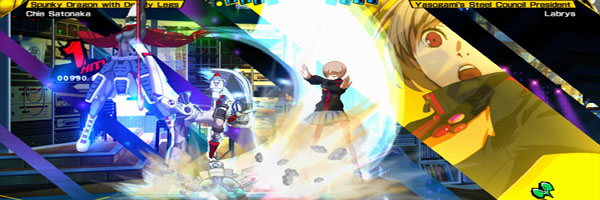
This is certainly one of the more unique collaborations to have happened. The game basically takes the story elements from the Persona team and adds in a fighting game developed by the makers of Blazblu. The music, art style and voice acting will be familiar to Persona fans and it certainly sets the scene very well.

The story is set a few months after the events of Persona 4 (and several years after Persona 3), and has our hero returning to Inaba to visit his friends. Upon arrival it soon transpires that something isn’t right, a feeling that’s confirmed when the midnight channel bursts into life once more to show all the main protagonists as targets for a strange new tournament.

From then on our team decide to dive into the world inside the television once more and soon become locked into a battle against each other. It’s fair to say that as plots go it’s completely crazy. It makes the plot of the original Persona 4 look positively normal and realistic in comparison. But it’s best not to think too much about it and just go along for the ride.

Along with the main playable cast from Persona 4 there are also a couple of the investigation team from Persona 3 and some new ones thrown in for good measure. The thematic choices in storyline and design of the boss character may ring a few bells with Blazblu fans and it has Arc Systems personality stamped all over it. That isn’t to say characters from Blazblu are copied over to here – far from it in fact, but there are certain times you can see the core of a Taokaka or Nu 13 spread across a couple of the characters move sets.

A fighting game lives and dies on its combat system and Persona 4 Arena has one unlike any we have come across before. Arc Systems have not created a Persona 4 version of Blazblu and have instead tried to produce something that fits the characters and game world more completely. 

Along with the usual super and special moves there are a fair few unique things to look out for. Attacks are designed around the four face buttons with the square and X buttons making your character perform light and heavy attacks. The interesting part of the system comes with the triangle and circle buttons. These are used to summon your persona to attack. If carried out carefully and precisely it’s possible for both your character and their persona to hit at the same time. This opens up the possibilities for big combos if executed successfully.

It’s also possible to disable an opponent persona by striking them. Do this enough and they will need to recharge before being used again. This gives a major advantage to the attacking player as it effectively cuts your opponents move list in half. 

The combat system is deep and will take a very long time to master. It is also not really comparable to other fighting game systems which means for hard core fight fans you are going to need to re-wire your brain to think in a new way in order to get the correct flow and timing. Luckily there is an extensive tutorial and challenge mode available to get you used to the new characters and the way the game works.

Hitting the square button continuously while your special bar is filled carries out an auto combo that leads into a super move. This may well be aimed at getting more casual players involved but it doesn’t really serve much of a purpose and can certainly end up being overused.

Something else that may need levelling out in an update is the ‘awakened’ mode that characters drop into when they fall below a certain amount of health. In our experience, both against the computer and other humans, this proved to be far too powerful. Opponents who simply weren’t in the contest suddenly managed to destroy our health bars, sometimes within seconds of awakening. We are all for leveling things up but we hate to think how this could be used by someone who had put hours into training.

The other thing that seemed to be slightly off was the games focus on trapping characters against walls. Again, whether playing against the computer or a human it seemed far too easy to be forced against the edge of the screen and simply be spammed over and over by the same cheap move (even the computer does this). The ability to attack as two separate characters often seemed to leave no way out.

We’re sure with training all these points can be counteracted but new comers to the genre may well be put off by the high entry level required to progress. That said, is Persona 4 Arena really the type of game that anyone other than a hard-core fan might buy? You could argue it isn’t. But then we can envisage a fair few RPG fans picking it up, maybe not that familiar with other fighting games, and being roundly ground into the dirt by it. 

This frustration is also compounded by the fact the standard PS3 pad doesn’t seem to be up to the input requirement needed. An arcade stick works fine but this is certainly the most precise input we have come across in any console fighting game. When a Street Fighter veteran can’t pull off a double fireball input every time you know something is a little off. Again, this may well be worked out in a patch but for now perfect precision is key.

Negatives aside, there is much to like about this. The story mode in particular captures much the same feeling as that of the original Persona 4. The story itself is interesting and told in a dedicated story mode where players will take control of each of the characters as the mystery unfolds.

There has also clearly been a lot of care and attention into making this game feel a part of the Persona universe. All of the characters remain true to types and act in the way fans will expect. The presentation and art style is also of the highest of standards and ticks the boxes for both bringing up nostalgic memories of the original source material and excitement about seeing it used in a new way.

The game does throw up some truly spectacular battles as well. When you find a character you’re comfortable with and get to grips with the game system it really does open up into a veritable wealth of different attacking options. It certainly isn’t lacking in flashy special moves either and at times things can become a blur of sparks and colour as characters and personas smash around on screen.

Chances are you already know if this game is going to appeal to you. This game will find fans with both Persona 4 players and gamers who spend their days mastering combos in Street Fighter, Blazblu and King of the Fighters. The fight engine is solid and the game is filled with charm. Be prepared to have to put the hours in though, this is a game that needs to be mastered in order to get the most out of it. 

8/10

Friday, 8 February 2013

Retro 101's Favourite Beat'em Ups Part 4: The Best of the Rest

We all know that SNK and Capcom are the undisputed kings when it comes to creating beat'em ups, but over the years many other companies have tried and failed to make an impact on gamers. Among the piles of trash (Rise of the Robots, Shaq Fu), and the exceedingly average (Primal Rage, Brutal: Paws of Fury), are a handful of games that are actually pretty good.

Waku Waku 7
wakuwaku7.jpg

Waku Waku 7 is one of the weirdest and most wonderful games we have ever come across. The game itself is a polished title from sunsoft that bases itself on the classic SNK four button template. What sets it apart is the mad cast of characters and super bright colour scheme. This title, you see, is a completely crazy parody of Japanese anime.

The bizarre combatants include a giant Totoro style Japanese soft toy creature and a walking tank with a gun for a head. The moves are over the top and it all rolls along at a lively pace. It's unlikely that Waku Waku 7 will hold players attention for as long as something like Street Fighter Alpha 3 but it is undeniable fun and anarchic.

Waku Waku 7 is pretty difficult to find. The home version will need to be imported on the Saturn or Neo Geo and neither is cheap.

Guilty Gear X2
guiltygear2.jpg

Guilty Gear X2 is a thing of true beauty and genius which looks amazing and plays even better. All the characters are remarkably different and players need to spend some time trying them out to find someone suitable to their style. The thing that really sets it apart from every other fighting game is the absolutely phenomenal level of depth it has.

We could list all the different features and techniques but it would take all day. It can be intimidating for newcomers but once you get your head around multiple special bars and different types of counters and cancels it all blurs into some heavenly stream of consciousness. Watching two Guilty Gear masters at work is mesmerising and the game is so engaging that you may well want to stick with it long enough to become one yourself.

Mortal Kombat 2
mk2.jpg

Mortal Kombat is by far Midways best known and most successful franchise. The original game is fairly archaic and only stuck around thanks to a wave of media attention and later games always seemed to lack something. However, despite not being the most technical game in the world, Mortal Kombat 2 is still really good fun.

The overall feel has been improved and characters are much easier to control than in its predecessor. The mass of different special moves, distinctive character designs and imaginative arenas also helps to hide the fact that most of the fighters core moves are all the same.

You can't deny the game has personality in buckets and there is more than enough here to occupy players in both single and multiplayer. There are decent versions of Mortal Kombat 2 on the SNES, Megadrive and, surprisingly, the original Gameboy. There is also an arcade version available on one of the Midway Arcade Treasures compilations but it feels a bit lose to us. The Mortal Kombat Anthology, which contains all the characters from the first three games, on the Playstation, is also well worth a look and there are also compendiums on Xbox Live and the Playstation Network.

Killer Instinct
ki.jpg

Rare's combo heavy fighter made a massive impact upon release but returning to it now it's clear it can no longer hold it's own with the big boys and can feel a little clunky. However, Killer Instinct is still a very playable and enjoyable game and acts as a kind of middle ground between Street Fighter and Mortal Kombat with a few of it's own tricks added.

One difference is that it isn't split into rounds. Players each have two health bars, when one is depleted the character falls to the ground for a second and then gets back up. This makes scoring a perfect on your opponent even more humiliating.

The other big thing the game brought was the combo system. Killer Instinct was the first game that really focused on the idea of certain moves linking into other moves and executed it well. The game takes the concept to an extreme and players can set off massive successions of blows heading towards the hundred mark.

Killer Instinct is available on the SNES and there is also a decent version for the old Gameboy. There is a sequel on the N64 but the pad isn't really up to it.

IK+
ik.jpg
The one-on-one beat'em up didn't really get into its stride until the 16-bit machines came about. However, there are a few games that did the genre justice before then. Barbarian and Fist of the North Star are worth a look but IK+ is by far the best of them. It is also unique in the fact that you are fighting against two other opponents.

This idea of having three fighters on screen was later used in Dragon: The Bruce Lee Story and in co-op modes in some of the later Street Fighter games. Players also don't have an energy bar but need to score a set number of points to the win the round.

You have a wide range of martial arts moves to take down your opponents and you need to move quickly as the other two fighters can score points off each other as well. The now legendary feature of IK+ is that you can make the players trousers fall down by pressing a certain button. It may not be revolutionary but it can't help but raise a smile.

IK+ is available on just about every 8-bit computer system known to man. It is also available on the Wii Virtual Console in the UK and is a must buy at 500 points.

Monday, 15 October 2012

Retro 101's Favourite Beat'em Ups Part 2 - Capcom gets the Marvel License


If any company knows how to make a decent beat'em up, its Capcom. Between the mid 90s and 2002 Capcom first held the rights to use Marvel super hero characters and decided to use them in games across a number of different platforms.Out of this came a number of excellent fighting games.
We here at Retro 101 are sick to death of only seeing Marvel vs. Capcom 2 paraded around in every magazine and on every internet site while the other games in the series go relatively unnoticed. That is why we are happy to redress the balance and present a feature on all six of the retro Marvel 2D beat'em ups.
X-Men: Children of the Atom
The first and generally most ignored of the five fighters is the sublime X-Men: Children of the Atom. The game was something of a benchmark at the time of release with its huge characters, massive destuctible stages and the introduction of technical elements that would become common place such as air blocks, tech hits and reversals.
There are eight characters to choose from, each of which is incredibly different from the other. Each of the combatants has a different style and requires a lot of practice to be effective with. Furthermore, each fighter is designed to act as a nemesis for one of the others. For instance, Wolverine has a really hard time taking down the Sentinel, while Omega Red will quickly take out Cyclops.
Children of the Atom is a difficult game and will certainly take some time to get used to. The old jump kick and sweep combination that many gamers are used too won't do much good here, as the characters move sets simply don't work like that. Once you get to grips with it all though, it soon becomes clear just how far ahead this game is from the rest of the crowd. Even now it retains a sense of being unique, and as such still has much to offer fight fans.
Marvel Super Heroes
After the technical showcase of the X-Men game came this much more frantic and over-the-top offering. Eight fighters are available, but now most of the X-Men characters have been replaced by the likes of Spiderman, Hulk and Captain America. The scenery is still big and impressive, though there is much less crumbling of floors.
Where as Children of the Atom was based around basic moves being used to parry and counter, this title relies far more on characters special powers. There is also a selection of magical gems that can be used to give your character a boost. It may be the less technical title, but it is arguably more fun due to the faster pace, softened difficulty level and screen busting moves. The two games are very different in there approach so there is no excuse not to add both to your collection.
X-Men vs. Street Fighter
So we come to the first time Capcom decided to mix its fighting franchises, and it proves a master stroke. By now all memories of the technical bouts found in Children of the Atom are long gone, replaced by taking some of finest characters from the two franchises and letting them bash the living hell out of each other in the most fun and stylish way possible.
X-Men vs. Street Fighter introduced Gambit and Rogue into the fight for the first time and also added the ability to tag in a partner. Players now pick two characters to take on two opponents with both having to be defeated in order to progress. The constant tagging, even faster pace and even bigger special moves produce a real spectacle.
However, the game is not without its faults. The most noticeably of these is that each of the characters has at least one infinite combo. We're sure that many a player has been reduced to tears by a merciless pro hitting them with string upon string of unstoppable, never ending attacks. As well as this there are a few balancing issues with certain super moves being far superior to others. Flaws aside though, X-Men vs. Street Fighter remains a fun experience.
Marvel Super Heroes vs. Street Fighter
As you might expect, this second entry in Capcom's vs. series is quite similar to the first. The major difference is that now instead of the X-Men there are characters from the whole Marvel universe. Cyclops, Omega Red and Wolverine make it through but the others are replaced by Spidey and co. Fan favourite Iron Man is surprisingly dropped though.
While on the surface things may seem a little too similar there have also been a number of refinements and tweaks implemented. The infinite combo moves are now long gone and the game has undergone a rebalancing. This makes what could have been a somewhat lazy follow up become a decent streamlined and refined effort. There is also an extra boss character to be dealt with. It may seem like more of the same but it is still as fun as any of the other titles.
Marvel vs. Capcom: Clash of the Super Heroes
The first Marvel vs. Capcom introduces characters from Capcom's back catalogue into the action such as Strider and Mega Man. The game remains two-on-two, though now a third character can be called upon to jump in with a special move. The super moves have once again been ramped up in style and are now much easier to execute.
Unfortunately, Marvel vs. Capcom is arguably the weakest of the six games. Some of the characters are wildly unbalanced and it can be hard to tell when your character is getting hit due to some weak impact sound effects. The game also has one of the most frustrating and cheap boss fights in history.
Marvel vs. Capcom 2
The final and most grand entry into the series, Marvel vs. Capcom 2 pulls out all the stops to create a frantic fighting game. The matches are now three-on-three and the roster has been boosted up to include fifty-six playable characters. All the fighters from the previous games are here, along with combatants from pretty much every other Capcom game.
Tagging and special moves are now even easier to execute with two buttons being used for just that purpose. Unfortunately, because of this, we lose the Capcom standard configuration of a light, medium and hard kick and punch. The four remaining buttons are assigned to light and hard attacks. This may take away some of the tactical approach but it certainly helps make the matches move along at a break neck speed.
This really is a classic game. Aside from a couple of the characters (well, aside from Cable), it's balanced nicely and will take you days to find your perfect combination of three. The only slight complaint is that the sound is once again a little weak with impacts being hard to distinguish and the music not really fitting with the action. But these are minor points.

Friday, 12 October 2012

Retro 101's Favourite Beat'em Ups Part 1 - SNK

SNK games are often overlooked due to their hardcore nature and difficulty to find in Europe. But any gamer worth their salt knows of the team's talent when it comes to two dimensions. So forget your Ryu's and six button fighting systems (if only for a little while). Let us be your guide to some of best fighting games you may never have played. Of course, there are other SNK beat’em ups available that aren’t listed here. Simply put, we really don’t rate The Art of Fighting and some of the others.

World Heroes 2
world-heroes-2.jpg
Though a fairly simplistic fighter, World Heroes 2 does have a lot going for it. One of the things that set it apart is the expansive and colourful cast of characters based on historical figures. What other fighting game allows you to pit Hulk Hogan and Bruce Lee look-a-likes against Joan of Arc?

The standard two round mode only acts to show up the games shortcomings. Select the Death Match mode however, and things suddenly become a whole lot more interesting. Here two fighters battle over a single energy bar during one extended round. The best aspect of the Death Match is the obstacle filled levels you fight in. Some stages have metal blades running along the floors, while others are strewn with landmines or take place in a small metal cage.

World Heroes 2 may not be the most technical game, but once you switch it into the Death match mode it can still offer something to fight fans today. If you want to try a game that's a little different then hunt it out


Samurai Showdown 2
ss2.jpg
For many this mix of martial arts and swords is SNK's finest hour. Here at Retro 101 we don't hold it in such a high regard, but we do still love it to pieces. The Samurai Showdown series is one of the most unique fighters out there and this second iteration is one of the finest fighting games available.

In this sequel more characters were added, along with the POW finishing moves. More importantly, the game was fine tuned and balanced to be much more even than the first. What we end up with is a tense series of bouts where any wrong move could be your last.

Fitting for a series concerned with weapon combat, the basic gameplay requires quick strikes when an opening presents itself, rather than long combo sequences. This can seem tough for newcomers as three or four strong blows can end a round. For those that learn the ways of the sword though it soon becomes clear that Samurai Showdown is as much about knowing when not to strike as it is about attacking.


The Last Blade/The Last Blade 2
lastblade.jpg
This often overlooked other weapon based fighter is, in our opinion, the best of SNK's 2D fighting games. While Samurai Showdown III and IV ended up fun but uneven these two games are a lesson in balanced combat where mastering your character is the key to victory.

Each character is different and all have their own strengths and weaknesses. They can also be customised by picking different attack forms. The first game lets you make your fighter either speed or power based, while The Last Blade 2 adds an EX option as well.

The difference between the three styles makes a remarkable impact on your strategy. It also looks beautiful and each new area is presented with a subtle cut scene beforehand to add atmosphere. The special moves are not massively flashy but it all keeps with the games ethos of balance and skill. Everything about the title(s) leaves you with the impression you have just played something destined to be a classic.


Garou: Mark of the Wolves
garou.jpgThis re-imagining of SNK's long running Fatal Fury series was developed to provide competition to Capcom's Street Fighter 3. Perhaps surprisingly, it almost manages to match Ryu and friends. The action is fast, tense and fluid and each of the characters has a real personality of their own.

Mark of the Wolves is a distillation of all the good points of the Fatal Fury series over the years and also throws in some wonderful tactical features. For instance, blocking at exactly the right time creates the chance to parry your opponent's attacks for big damage. Also, a new T.O.P bar is placed on your characters health meter. When you drop into the bar it allows for a new technique to be used.

As a reinvention of a franchise it is hard to think how a better job could have been done. From a slightly ageing and creaky bunch of titles a vibrant, skill based and flair filled fighter has emerged that really does deserve all the credit it gets.

The King of the Fighters
kof99.jpg
The proverbial SNK team based cash cow. Ever since the first title way back in 1994 a new game has appeared almost yearly. While none of the games are bad, the real cream of the crop appeared between 1996 and 2000. After that, the focus seemed to be more on making things look flashy in 3D, though King of the Fighters XIII is excellent.

For those that don't know, the King of the Fighters titles allow you to pick a team of SNK's finest from various games and take on other teams. When one player is knocked out the next in line joins the battle. Certain versions of the game also introduce a fourth striker character that can be called upon to use a sneaky special move a limited number of times.

Considering the amount of fighters on offer the game remains remarkably balanced. It also requires players to learn many more moves and strategies than they would normally as you need to be handy with a number of different characters to succeed. A few minor balancing issues aside the series always remains fun and highly enjoyable.