Bitmap Books

Showing posts with label Thunderful. Show all posts

Monday, 30 March 2026

Planet of Lana II: Children of the Leaf Review (Switch)

We were a little surprised to see Planet of Lana receive a sequel. The charming first game is one of the most beautiful looking and sounding indie platformers out there, but it felt like one of those flashes in the pan moments of genius and it’s not exactly like cinematic platformers are that prevalent.

The second game, somehow, looks even more beautiful and continues the story of Lana and her weird pet Mui as they adventure across the planet of Novo. It’s set two years after the events of the first game (which is deftly recapped) and shows how the various tribes and factions have taken to the now discovered technologies scavenged in the aftermath of the first.

Lana has a host of new ways to move around, with faster movement, sliding and things like wall jumps and the ability to swim now in place. As a result, movement is much more fluid than the original, but the platforming sections or also a bit more fiendish as well. The heart of the game though is about solving puzzles. Early on, Lana will normally be given requests from settlers and then head off to find something. This acts as a good introduction to her new skills while showing off the gorgeous visuals and setting up a healthy chunk of world building.

Almost all puzzles require you to use the two characters in partnership with each other. Mui can manipulate technology and pass control on to other animals. So, most puzzles fall into a pattern of working out how to get Mui to a point they can take control of something, then working out where that goes and then getting Lana to race to the new location. An early example of this is where Lana needs to retrieve a particular piece of seaweed from underwater. It requires getting Mui into a shallow pool of fish, then getting the fish through a dangerous area using its ink special skill and then getting Lana to clear a path and then trap a predatory fish before her air runes out.

It’s quite different from the original game in terms of how it plays out. In the first game you were normally hiding or running away from technological monstrosities. And while that is still the case in places, this is much more about using the different animals and interacting with the population. The game feels much more alive as a result.

With most puzzles having a clear timing element it means players need to be precise and agile to get through as well. Controls are slick and precise though, so frustration rarely comes from a clunky input. The game is also exceptionally well checkpointed, so when you do die there are no long sections to retrace. We also found the game was far less frustrating than the original with regards to its puzzle design with it being clear most of the time what we had to do.

Planet of Lana is a beautiful game, but the sequel is off the charts. From the villages to mountain tops and the technological encampments it all looks astounding. The score that goes with everything is also exceptional, really breathing life into the locations. Progress is rewarded with visual highlight after highlight, and it really does keep players pushing through the game. The art design here is akin to something studio Ghibli would be proud off, it’s simply breathtaking.

Overall, Planet of Lana II manages to somehow be even better than the original. Every aspect has been improved, and the original was already an exceptional game. The sharpening of Lana’s movement is a delight, and the majesty of how the game looks makes it irresistible. It might just be a touch short for a few people but then its still longer than the original. It’s hard to see anyone not liking this. It comes highly recommended.

Overall 9/10

Monday, 27 May 2024

Planet of Lana Review (Switch)

 Written by Thomas G.J. Sharpe

Thankfully, this is not a terrifying vision of an entire global sphere populated by Lana Del Ray clones that sing interminably, this is another cinematic platformer, and a darn good one at that! Much of the early coverage of Planet of Lana focussed on the visuals, drawing slightly basic comparisons to Studio Ghibli. While this comparison is correct in level of finish, the three-and-a-bit hours I spent with the game belie an interesting style of its own, no less beautiful, and a brilliant blend of puzzle, platform, and story.

This short, but well-formed, adventure starts in the titular Lana’s village. A coastal accretion of shacks and huts, with a population living out quiet lives. You learn the controls following your sister around and discover a sad family history. Then, in timely fashion, robo-aliens start piling through the atmosphere and do a kidnap job on everyone, which the nimble Lana is able to evade. These charmingly designed robots leave Lana alone, save for a small black cat-like creature called Mui. This is Limbo and Abe’s Oddysee for fans of Journey in a Wind-Waker colour palette. I dunno, the comparisons are still slightly non-functional. I was reminded of Brothers, obliquely, with the twin dynamics of tragic-adventure and co-operative puzzles. Lana and Mui work together to traverse the landscape, tame wildlife, and trash robot invader plans.

Some shots are just for show. The camera pulls out as you chase Mui down, wider and wider, until there’s a boulder crammed in a leafy canyon. There’s a tree sticking out of the top. It’s just for effect, played slow and careful. Lana trudges across a desert, despondent and defeated, everything lost (but a set up for an exhilarating reversal before the climax). Wishfully Studios have crafted something that has less vicious edge than its most obvious ancestors, Limbo and Inside. There was a longing, or hope against hope, that came to me from the sublime Spiritfarer. Lana is just capable enough, but there is a lonely and dangerous quality to the game. In this is my only real gripe, that many of the puzzles were a frustratingly tightly timed series of actions. If you failed to pull it off, there was a little long to get back into it, and often some setting up or pre-positioning that became real old, real fast if you’re stuck. This is certainly a personal problem, as I have such low patience, and such I am not docking too many points off Planet of Lana. Most puzzle or platform players will find this fine to accommodate.

Of particular note is the music. The score is so deftly handled that there is a real built sense from the small, yet bustling village, the peace of a forest gravesite, and quiet childhood games, to the soaring chase scenes, tense stealth sections, and eventual sci-fi battle grandeur. The compositions are linked with recurring motifs and themes, perfectly placed. There’s horns and bleeps and pads and all sorts. Just a real joy to experience.

Planet of Lana lasts around three to four hours (I was closer to four, but after looking playtime up, most did it around three, so I just suck) and is a taut experience that blends the best of this genre together. Between its presentation and its gameplay, there is huge value in a small package. Its core strength is this brevity, as the formula would not, in this reviewer’s opinion, have lasted to five hours. The push-me-pull-you, stelf-jump-stelf pattern is deployed for the right amount of time to engage us in a well-crafted adventure story, and no more. Knowing when to stop is a real virtue in games. Wishfully have made something special, intimate, yet grand, that seems to fit in your pocket.

Overall 8/10

Monday, 9 October 2023

Crowns and Pawns: Kingdom of Deceit Review (Switch)


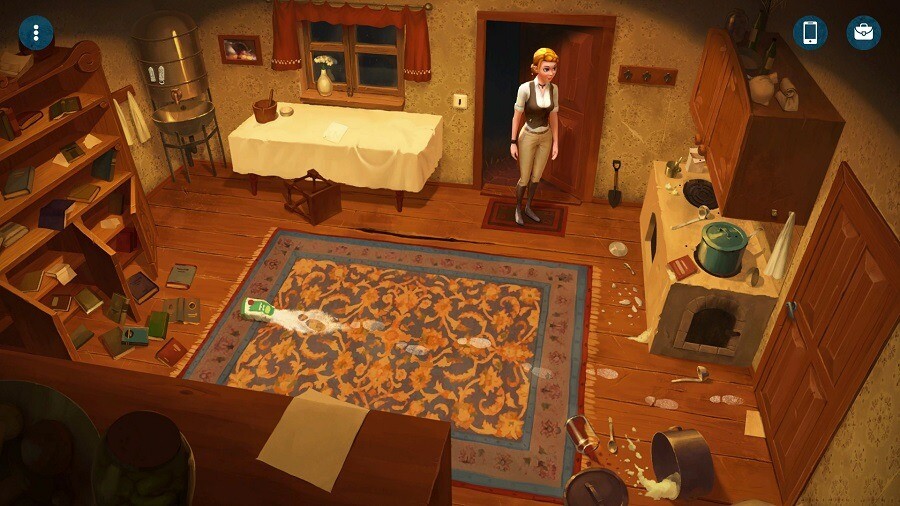
Of all the retro revivals happening at the minute the beloved point and click game is still somewhat underutilised on consoles. There have been some highlights of course with Broken Sword 5, Monkey Island and Roki being particular favourites, but compared to Metroidvaias and Rogue-likes there isn’t the strength in depth you might have hoped for. This is changing though, as the original Broken Sword and a new sequel are coming. Speaking of Broken Sword, here we have Crowns and Pawns which is a game clearly inspired by it and a title that should keep you busy until the triumphant return of George Stobbart.

Crowns and Pawns follows Milda, a girl with Lithuanian heritage who inherits a house from her grandfather which sets in motion a chain of events that sees her exploring the lesser highlighted areas of Europe and European history. The setting is a nice change from the norm as countries such as Lithuania offer a rich cultural and historical heritage to explore which will likely be less familiar to players. It’s something more developers should think about when choosing the settings for their games.

Of course, as soon as Milda touches down it becomes obvious there is much more going on than simply sorting out her grandfather’s house and soon, you’ll be caught up with the KGB and looking to uncover a long-hidden secrets and mysteries. This does play out in a way similar to the Broken Sword games with a lot of historical researching and visiting of churches and other cultural sights. But Revolutions game certainly doesn’t have a monopoly on churches so while it feels familiar it never moves into full copying territory.

There are two main processes to solving puzzles. The first will be familiar to point and click fans in that you move around areas picking up objects, combining when needed and then using them to solve a location-based puzzle. An early example of this is needing to figure out how to get a key from between a crack in the floorboards which requires magnets and string.

The other thing the game has you doing is combining notes in Mildas phone. For instance, when reading a book, she will often mark down important things such as locations or dates. You may then need to combine these with a note which says something like “My grandad was looking for treasure at a church”. Matching the two things will then normally give Milda a revelation leading to a new line of enquiry or a new location to go to and explore. The system itself is not particularly complicated but we did find ourselves stopped in our tracks a bit too often with this and starring at notes in her phone is far less interesting than interacting with the world.

Being stopped in our tracks is a bigger issue with the game as well. You’ll always get those moments where you aren’t quite sure how to solve a puzzle in point and click games but the clue giving in Crowns and Pawns is slightly off and not quite good enough too often. A lot of the time we didn’t have any idea what our goal was even when we asked what we should be doing, or we felt we had already done it. When you have a clear thread of what to do the puzzles are very good but too often, we found ourselves wandering aimlessly.

Overall, Crowns and Pawns is a fun and worthwhile game for point and click fans. It may be a bit unrefined in terms of its dialogue, but the puzzles, locations and general story are interesting and engaging. If you can get over the stop start nature of the game, then it is well worth playing as there is a lot of charm here and it’s clear the developers had a lot of passion for the project.

Overall 7/10


Monday, 31 October 2022

Lego Brick Tales Review (Switch)

It seems strange that over the years very few Lego games have been focused on the core building aspect of the little plastic blocks. Lego Brick Tales is looking to change that without relinquishing the story aspect completely.

Here, we effectively have an original, non-licensed based, Lego adventure which is more heavily based around puzzle solving than any of the game in the franchise previously. You play a Lego Minifigure who is tasked with helping his grandfather rebuild a run-down amusement park. In order to do this, you have to go into different themed biomes and find magic crystals.

The biomes are themed around locations such as desserts, jungles and Medieval castles and you make your way through them by talking to other minifigures and solving their problems through building things. The first jungle biome isn’t the best, but things do pick up considerably once you move on from there with the game mostly staying on the right side of being fun. Just expect to be building a lot of bridges.

The building aspect can best be described as working functionally. When you must build something, you are moved to a self-contained space with all the shapes available to you set out on the floor and an allotted space set up for you to build within. Along with this you’ll get key instructions such as ‘place pot on top’ or ‘use three elements’, but for the most part you are free to use the pieces how you see fit. There are a couple of occasions where the instructions aren’t particularly clear but on the whole, nothing is too obscure and while bridges do pop up a little too often, you’ll also be building working machinery and other things to keep it interesting.

The biggest barrier to your building is the control scheme. No matter how many hours we put in, it never became anything other than a bit awkward. Though the team are continuing to look at this and further patches are incoming. A Switch control scheme is never going to match that of a human hand but again, we did get used to it and after getting through the first biome it rarely caused enough of an irritation to stop us completing the builds.

Like a lot of the Lego games there is also this relentless sense of fun and creativity that runs through it. It’s just wonderfully charming to the point that when you hit one of the bits that doesn’t quite work it’s easily overlooked because two seconds later, you’ll be talking to a Lego ghost or collecting Lego hermit crabs and it’s impossible to stay frustrated.

Overall, this is a good attempt at trying to merge the idea of free brick building with something story based that isn’t attached to a major license. It is a bit rough around the edges but the key elements such as the charm and feel of a Lego world are present and once you have got used to its quirks there is a lot of enjoyment to be had.


Monday, 12 September 2022

Cursed to Golf Review (Switch)

Another day and another Indie Rogue-like appears. This one however is somewhat unique as it sees you as a golf player, struck down by lightning, needing to make it through 18 holes in order to escape from a cursed golf-based purgatory. While it takes the popular 2D platformer approach (but with golf?), we certainly haven’t played one like this before.

Awaking by the Eterni-Tee golf shop you are introduced to the spectre known as the Scotsman who explains the basics to you and that in order to escape, you’ll need to play a cursed and impossible 18 holes for all eternity. It’s a simple premise – complete each hole within par and if you fail you are dragged all the way back to the beginning hole, no matter how far along you are. It’s a good thing there’s a driving range to practice on.

Of course, these aren’t ordinary golf courses and are filled with traps, spikes, boxes of explosives and all manner of other things you’ll need to negotiate. Each course can be tackled in numerous ways and there are short cuts and teleporters all over the place. The Rogue element starts to kick in when you realise the courses are all remixed should you fail and need to start again. Later you’ll get the ability to set a checkpoint but even that only works for one death.

Along the way there are a number of things to help you. Within the courses there are totems which when struck add shots to your par counter, a golf based health pack if you will. There are also cards you can play which do everything from create multiple balls to turning your shot into a rocket. These cards can be picked up from the map screen or purchased from the shop in mystery packs and are vital to making any sort of substantial progress.

The holes themselves are fiendishly designed and you will see a change in environment as progress with areas like deserts providing extra sand traps for example. Each hole works as a kind of puzzle that players will need to check through for routes and totems in order to see the best way to progress. It’s just a shame that you’ll end up playing the first few areas much more than the later ones. The first time we got sent all the way back all we really wanted to do was go out and try the second areas courses again.

There are also boss battles of sorts where you must reach the hole before the guardian of the area. These are very tense and a highlight of the game. Here a new totem is added which when struck freezes the guardian for a turn, and you’ll need them. Once a boss is defeated, they remain so for future play throughs in a rare concession to giving the players a feint glimmer of relief.

Like most Rogue games the game will take time to click with most players. We found it was around round 6 where suddenly the games techniques clicked with us. From here we felt we had a good understanding of the three clubs, the need for cards and how to utilise the spin on the ball to make it change direction on the ground. Before that it really was a bit of a struggle.

There are some notable issues with the game though. First of all, trekking all the way back to hole 1 no matter how far through you are or what region you are in is a hard pill to swallow. Even Spelunky gives you short cuts to new areas but there’s no such option for players here. To compound this is the fact it takes a long time to get through holes. They are fairly lengthy and even fast forwarding, the number of animations you have to get through from setting, striking the ball, watching the ball, moving to the ball etc is just too much to keep things flowing quickly enough. When you start adding some issues with pixel placement of traps, more than once we have visually cleared a sand trap or made a ledge only for the ball to still fall foul due to the collision detection, it can put up quite a wall for players to try and break though.

Overall, Cursed to Golf is almost a very very good game. All the good stuff is here and all the minor issues with the game could be overlooked if there was of way of creating permanent shortcuts to the different areas. Of all the rogue games we have played this is one least suited to having to get through it all in one run as it takes so long to actually get through the holes. It’s fine to have it as an extra option but a simple permanent checkpoint in a couple of the areas would have turned this from a good game into an unmissable one. As it stands most players will likely give up long before the end.

Overall 7/10