A year after the first release this new version of Space Hulk looked to build on the foundations of the first game and bring the digital version of the franchise close to the realms of a turn based strategy game rather than a recreation of a table top board game and as such a host of new features have been implemented.
Sunday, 31 May 2026
Space Hulk Ascension (Warhammer Classics) Review (PC)
Monday, 11 May 2026
Warhammer Classics Round up (Steam)
Recently, a load of Warhammer games have been picked up and republished on Steam. We will be covering some in more detail in coming weeks. But here is a round up of one of the bundles that is available currently. It’s worth noting that almost of all of these are complete packages that include any DLC or extra content released.
Space Hulk and Space Hulk: Ascension
We have covered both Space Hulk and Ascension before a good
few years ago. The first Space Hulk game does a pretty good job of recreating
the board game experience. As a result, though it can feel slow and clunky in
places. Ascension adds a bit more into the mix with the ability to level up
your characters and having maps created from scratch. Both games are incredibly
tough, but fans of the original game or Warhammer 40,000 are well served here.
Just don’t expect anything too pacey.
Warhammer: Dark Omen and Warhammer: Shadow of the
Horned Rat
Our first experience of both these games was with their
release on the first PlayStation. You would have hoped that using a mouse would
have brought a better control scheme, but they are extremely clunky with a very
small window to view the actual battlefield from, as most of the screen is
filled with the user interface. Yes, instead of using the mouse you must
control the game with different on screen buttons. These were clearly developed
with the console ports in mind. If you can get into them, they are tough and
engrossing, but we really struggled and found the games far too frustrating to
stay with for long. Still, if you want to take on hordes of Skaven or the
Undead it certainly has some scale to it.
Warhammer: Mark of Chaos
Finally, proper mouse controls come to Warhammer. Many see
this as the sort of precursor to Total Warhammer. It’s like the Lord of the
Rings strategy games in terms of it using smaller groups of characters and
telling its own story. There are campaigns from the Empire and Chaos sides with
the DLC adding the Orcs and Goblins. Further races such as Dark Elves and
Skaven can be played in multiplayer. It’s certainly not perfect but it’s a game
we fought our way through on the Xbox 360 and loved, and naturally it plays a
whole lot better here. It’s a lot of fun with a solid campaign and a decent
enough multiplayer mode. A good progression from Shadow of the Horned Rat and
Dark Omen and though it’s lost a bit in terms of looks it plays perfectly fine
still.
Final Liberation
This is the PC attempt at getting Warhammer 40K Epic into
game form. The controls are pretty good and it’s easy to identify your troops
and move them around. There is also a ton of units and things you can do with
them. It is crazily tough though. Taking on the first mission on the easiest
setting we found our Marines always missed their shots, while simple groups of
Orks managed to destroy heavily armoured vehicles. Once you get the hang of it
though it’s an engaging game that certainly deserves a second life.
Warhammer 40,000 Chaos Gate
Note, this is the older version of the game. The Games
Workshop attempt at UFO: Enemy Unknown. Build your squad, equip them and then
send them into different missions to take down imperial cultists and demons. It
works well and there are a ton of customisations and weapon options available
for tackling levels in different ways. You can even use terminator marines and
other specialist categories like apothecaries and tech marines. It looks dated
but plays well. It’s worth playing for fans and we can see people losing a good
few hours of their lives to it.
Warhammer 40,000 Fire Warrior
Looked upon as a disappointment on release, Fire Warrior is
a perfectly ok FPS game. Now the hype has died down it certainly has it charm
(although it was certainly never going to be a Halo killer). You play as a lone
Tau warrior trying to fight off the Space Marines and forces of Chaos. It plays
well, has some impressive set pieces and runs at a decent pace. It certainly is
never going to be a stone cold classic, but fans of the theme and genre will
find a lot to like here.
Warhammer 40,000 Rites of War
It seems there is no genre or template untouched by
Warhammer. While Chaos Gate took on the Enemy Unknown template, Rites of War goes
down the turn based hexagonal grid route and draws inspiration from Panzer
General. The game has players taking control of the Eldar as they first fight,
then unite with imperial forces to fend off a Tyranid Hive fleet.
Like a lot of these games, it’s a mix of good and bad. The
classic mechanics are addictive and work well but missions are overly repetitive
and pestered by small annoyances. Enemies have a habit of running away and healing
before you can finish them off and characters can only carry a single object,
so if you get to the end of a mission with no troops left to pick up that vital
artefact you can’t complete the mission. And no, you can’t drop other objects
already picked up. All that said, the core of the game is good. If you are
looking for something that’s a bit more of a slow burn approach to Warhammer,
then this is well worth a look.
Man O’War Corsair
Corsair is pretty much the definition of being an overlooked
gem, if it was an indie game at least. It’s certainly the Games Workshop game
which had the most potential if it had continued to be updated. It’s basically
a rip-roaring pirate adventure set in the Warhammer world. Not only can you
fire on other ships at range but also board them and let crews fight it out on
deck.
There’s certainly a lot to like but the game is unpolished
and messy. A lot of the ports look the same, sea monsters descend into predictable
attack patterns and while naval combat is fun, when you get up close it looks
tired and feels clunky. If you are forgiving though there’s a lot of ambition
here to admire.
Sunday, 3 May 2026
Space Hulk (Warhammer Classics) Review (PC)
Space Hulk started life as a table top board game where heavily armoured Terminator marines from the Warhammer 40,000 universe, pitted themselves against the multi-clawed Genestealers aboard massive drifting freighters known as ‘Hulks’. The tight corridors meant it turned into a battle of the strong and slow versus the quick and deadly.
Monday, 16 September 2024
Shovel Knight Dig Review (Switch)
Shovel Knight Dig joins a small, but compelling, coterie of games that plunge down ‘tward the core like in that film where a group of scientists go to the centre of the earth to restart it with nukes, but the name escapes me.
Dig is on one hand really familiar territory. Blue Knight is back with his sort of unflappable-yet-flailing charm. The moveset is pretty much the same, as it has been, since Shovel of Hope, but there’s an emphasis on the digging (deeply unsurprising). You’re urged downward, making the most of Blue’s Duck Tails-esque pogo-shovel jump attack. Enough is changed by this 90-degree clockwise spin rotate, to give a fun, if short, addition to the series. Unlike Downwell, for instance, you are not in free fall. And unlike Raising Hell, you’re not going up. There is still a “room” quality to the progression. You go down, dig, collect loot, traverse environmental traps, shovel enemies, and that’s about it. Occasionally there are bosses to cap off sections, where you get a choice of two paths. Also, shops to change your loadout and thus alter your stats, help to give some purpose to the greed.
It is important to stress that this has rogue-lite elements to it. A persistent hub area with a host of wonderfully realised characters (by far, to me, the crowning glory of the series is the character design, animation, and writing). You collect armour sets, trade in gems for relics, and therefore have some control over your gameplay feel. This is, admittedly, quite thin, as the level traversal is the real loop here. And by loop, yeah, you go back into the hole in the ground caused by the schemes of (checks notes) Drill Knight, to pursue him and your pilfered loot, over and over until you get to the end. I haven’t gotten to the end, but all reports I have read seem to suggest a reasonably short experience of around five hours if you slightly backseated a 100% completion of collectibles, and were any good at it. I, for one, am not enhanced in my ability to play platformers whichever way the action in the game is moving toward, be it down, up, or the traditional right.
The game was responsive, looked great, and sounded superb. Another highlight of this series is the music, and this is no exception. Shovel Knight has consistently managed to find that sweet spot of nostalgia and newness, evoking something at once familiar and yet not tired, or second-hand. With a toe dipped into the one-more-round paddling pool, there is a different motivation than a traditional level-beating goal. It puts a lot of the load onto the satisfaction of competency through iteration. If you must repeat sections (however differently randomised) you get a keen sense of your change as a player. Part of my love of Hades for instance, was the creeping skill wall. The risk is, perhaps, how this sense of progression is felt by the player, and those permanent upgrades do help, but sometimes short play time can do it too. I will see where the load shifts to, or whether the pursuit of collectibles rears its strange head.
All in all, Dig is as consistent, enjoyable, and effective as ever. I consider these games to be a part of the high-water mark of the new platforming set. With the exemplary visual design, they’re not afraid to try these twists, like Pocket Dungeon, to capture a whole new way to engage with their gorgeous world and loveable characters.
Overall 8/10
Monday, 1 July 2024
Free Stars: The Ur-Quan Review (Steam)
Buckle up, as
you are about to take a bold adventure through time and space to a land of OLD
GAME. In this remastering (freemastering?) of Star Control 2, you can
feel the anxiety of gaming in the past as a gamer of the present as you game a
past-present game. Widely lauded, the Star Control titles from the start
of the ’90s broke ground on many forms of games we still see crop up today. If
you read about it, people mostly concoct a family tree to Mass Effect or
Stellaris, but also things like Fallout. The strongest a-likeness
I felt was one of the games of the century, Faster Than Light: FTL, and Highfleet.
At the time of Star Control coming out, I was just too young for
it. It would be over the subsequent couple of years that I’d discover point and
click adventure games, that led me into the world of games proper. While I
would soon enjoy being baffled by Elite 2 and played such sci-fi
milestones as Pickle Wars (shareware), I never encountered Star
Control. Now, this new resurfacing allows us all to experience a bit o’
history and hopefully a charming resuscitation of a classic IP.
I’ll warn
you, this is a strange and uncompromising title that is, so I understand, a
faithful porting. Be prepared to do a little research around its unexplained
edges. I especially came to confusion over controls. Piloting a wayward
research ship returning to Earth, your first encounter will most likely be with
an Ur-Quan surveillance drone that approaches when you close in to the planet.
Being briefly informed that humankind is now enslaved, and Earth is a sort of
zoo-farm, and the space-caterpillar police were soon en-route. After connecting
with a human slave to have an exposition dump, we are launched into a mission
to rally allies and compatriots to the cause of galactic riddance of the
insectoid overlords.
The Ur-Quan,
and all the creatures and characters, are colourfully voiced in this version,
with joyfully ludicrous animated portraits. These were roundly imitated by Fallout,
among other games, to good effect. The voice-acting is kitsch and camp and adds
a lovely Ed Wood vibe. The typefaces for each alien species remind me of when
the Neil Gaiman Lucifer comics helped provide accents visually with a
vivid range of evocative hand-made type. It would be worth entering this game
with a wry smile rather than a po-face, especially when you experience these
aliens. I remember the abject seriousness (and punishing consequences of
failure) of the Star Trek games such as 25th Anniversary and
Last Rites. This is not that, which was trying hard as it could to
legitimise its game tie-ins. Ur-Quan feels more like the absurd
bio-racer Vangers most of the time. Racing around different
space-vehicular minigames for resource gathering, combat and traversal. This is
an open-world survival game that has an alpine learning curve and, what feels
like, 8-axis movement.
You can visit
all sorts of planets, craft new ships, and primarily form relationships with
the alien cultures. It plods along well, but simple mistakes are hard to
recover from. I often found myself struggling to make ground on enemies, or
turning at the wrong point and losing lots of progress (almost identical to the
brutally gorgeous Highfleet, but for different reasons). It becomes a
little repetitive, and I eventually ran out of steam, but for the time it
endured, Ur-Quan was a wonderful experience, well ported. A lot of
jaunts down Dos Box lane that I’ve had over the years resulted in games simply
falling apart, or being themselves simply torturous to play. Enough has been
smoothed, and some accessibility options are present in this “museum” piece that
it is a worthwhile experience for curious gamers. It’s free, the hu-mans are
not!
Overall 6/10
Monday, 24 June 2024
The Darkside Detective Review (Steam)
Written by Thomas Sharpe
The memorable duo list is long, and while not
philosophically as potent as Rosencrantz and Gildenstern, McQueen and Dooley
in Darkside Detective are far funnier. I think you’re meant to
find Rosencrantz and Gildenstern funny. Or maybe ribbingly meta. Or hilariously
intertextual. But there’s more of the Morcombe and Wise in McQueen and Dooley,
thankfully. Rosencrantz and Gildenstern are visually reminiscent of Hall and
Oates, with their rakish flocculence, and this is arguably their only real
source of humour.
There’s certainly more of Sam and Max with McQueen and
Dooley, but without the American bombast. When, at the time of Indiana Jones
and Sophia Hapgood in Fate of Atlantis, Lucasarts point and clicks
never quite peaked the surreality of Sam and Max, and one could argue that
McQueen and Dooley in Darkside Detective are a successful
descendant. Especially in a vast landscape of over-zany (Edna and Harvey) and
perhaps over-whimsical (Vella and Shay) duos that read more like a Joss Whedon
script (largely interchangeable dialogue that could be attributed to any
character).
Darkside Detective, with it’s allusions to a broad
avenue of spooky pop-culture, delivers magic like Penn and Teller rather than
Siegfried and Roy. Joyful, ironic and minimal animal abuse. The writers have
managed to not just give textual homages at the rate of Pegg and Stevenson
in Spaced, but incredibly gave it breathing room where others get
bogged down in a referential mire. Maybe it’s just that Spooky Doorway’s silly
humour lightens me rather than paws at me, much like the comparable yet
different results of Reeves and Mortimer when set next to the at times
cringingly try-hard Fielding and Barratt. A similar result is the products of
collaborations between Pratchett and Gaiman, who maddeningly make something
less playful and fun than Adams and Lloyd, with their Meaning of Liff,
a true philosophical benchmark.
The puzzles and gameplay of Darkside are
balanced and largely amusing, rather than the travails of Rincewind and Luggage
in the egregious Discworld point and click, which is
notoriously left-field. Nico and George from Broken Sword were
left in the dust by contrast, despite that excruciating goat puzzle in the
first game. The big and blocky pixels are a reverse of Jake and Dinos Chapman,
subsuming the player in a just-rich-enough visual style to evoke nostalgia and
playful simplicity in good measure. Crucially, Darkside Detective tries
much less hard than the painful conceit of this missive, and is one of the
funniest games I’ve played in years.
Overall 10/10
Monday, 27 May 2024
Planet of Lana Review (Switch)
Written by Thomas G.J. Sharpe
Thankfully, this is not a terrifying vision of an entire global sphere populated by Lana Del Ray clones that sing interminably, this is another cinematic platformer, and a darn good one at that! Much of the early coverage of Planet of Lana focussed on the visuals, drawing slightly basic comparisons to Studio Ghibli. While this comparison is correct in level of finish, the three-and-a-bit hours I spent with the game belie an interesting style of its own, no less beautiful, and a brilliant blend of puzzle, platform, and story.
This short, but well-formed, adventure starts in the titular Lana’s village. A coastal accretion of shacks and huts, with a population living out quiet lives. You learn the controls following your sister around and discover a sad family history. Then, in timely fashion, robo-aliens start piling through the atmosphere and do a kidnap job on everyone, which the nimble Lana is able to evade. These charmingly designed robots leave Lana alone, save for a small black cat-like creature called Mui. This is Limbo and Abe’s Oddysee for fans of Journey in a Wind-Waker colour palette. I dunno, the comparisons are still slightly non-functional. I was reminded of Brothers, obliquely, with the twin dynamics of tragic-adventure and co-operative puzzles. Lana and Mui work together to traverse the landscape, tame wildlife, and trash robot invader plans.
Some shots are just for show. The camera pulls out as you chase Mui down, wider and wider, until there’s a boulder crammed in a leafy canyon. There’s a tree sticking out of the top. It’s just for effect, played slow and careful. Lana trudges across a desert, despondent and defeated, everything lost (but a set up for an exhilarating reversal before the climax). Wishfully Studios have crafted something that has less vicious edge than its most obvious ancestors, Limbo and Inside. There was a longing, or hope against hope, that came to me from the sublime Spiritfarer. Lana is just capable enough, but there is a lonely and dangerous quality to the game. In this is my only real gripe, that many of the puzzles were a frustratingly tightly timed series of actions. If you failed to pull it off, there was a little long to get back into it, and often some setting up or pre-positioning that became real old, real fast if you’re stuck. This is certainly a personal problem, as I have such low patience, and such I am not docking too many points off Planet of Lana. Most puzzle or platform players will find this fine to accommodate.
Of particular note is the music. The score is so deftly handled that there is a real built sense from the small, yet bustling village, the peace of a forest gravesite, and quiet childhood games, to the soaring chase scenes, tense stealth sections, and eventual sci-fi battle grandeur. The compositions are linked with recurring motifs and themes, perfectly placed. There’s horns and bleeps and pads and all sorts. Just a real joy to experience.
Planet of Lana lasts around three to four hours (I was closer to four, but after looking playtime up, most did it around three, so I just suck) and is a taut experience that blends the best of this genre together. Between its presentation and its gameplay, there is huge value in a small package. Its core strength is this brevity, as the formula would not, in this reviewer’s opinion, have lasted to five hours. The push-me-pull-you, stelf-jump-stelf pattern is deployed for the right amount of time to engage us in a well-crafted adventure story, and no more. Knowing when to stop is a real virtue in games. Wishfully have made something special, intimate, yet grand, that seems to fit in your pocket.
Overall 8/10
Monday, 6 May 2024
El Shaddai: Ascension of the Metatron Review (Switch)
Written by Thomas G.J Sharpe
Wise-crackin’ angels vaguely playing out a mangle of lesser-known Judeo-Christian texts? Sursum corda! You got it! And somehow, wherever I looked for information on El Shaddai, it was sprinkled in the risky words “cult classic”. Sadly, I simply do not see it.
This is pitched as a third-person action game (feat. Mild platforming) with some other bold claims than it’s cultish-classicism; “deeply artistic”, “outstanding aesthetics” and “exceptional setting”. Shaddai is proud of its design, and in a way, it probably still stands out after 10 years. It is “unique”, but I find it hard to apply “artistic” in the way I feel that the marketing wants me to feel about it. Stylistic might be better; it is an interesting blend of crisp, heavenly brightness with piercing colours that provide a jarring, otherworldliness, or even between-worldliness to it. In this way, Shaddai puts a lot of burden on the visual adornments to hook us in.
But it falls apart as soon as you squint past the divine rendering and play the game after a run of bargain-basement story-telling cinematics (these pop up constantly throughout the game, never once being interesting, tense, moving, funny or any such thing). You play as Enoch (quick search… ancestor of Noah… wrote a bunch of guff about demons and monsters to make ancient people (and the modern day credulous) terrified of everything) who is writing a bunch of stuff out in a bunch of books and is led by Lucifer (who has a cell-phone which he uses to smart-talk Yahweh on) to defeat seven fallen angels who have confused reality on Earth. Or something.
And I mean, or something. Because, despite the interest I personally have in the development of superstitious cults, like Christianity, this is not a compelling interpretation. Primarily, as the player never once cares about the fate of Enoch himself. He is devoid of sympathy and interest, there is no character arc to speak of. His struggles against amusingly designed enemies and bosses with his divine weapon-stick (looks like that awful company Tesla designed a Bat’Leth) are without risk. Not just in a narrative, conceptual sense either. The combat is, at best, functional. There is little to no development beyond a couple of mild combos. If you consider that Bayonetta was released two years prior to this, it really shows its weaknesses.
On the more positive side, yes, this is an interestingly designed game, and the mixture of 2D platforming into the 3rd person action is a nice idea. It never quite translates, however, going no deeper than mild changes of perspective and settings, thinking aesthetic abstraction is enough to win the day. It simply is not enough for me. For a game to not excite me that has as it’s primary game loop as hack-n-slash action, is shocking. Again, I just do not see the appeal. Neither fantastic enough, thrilling enough to inspire anything in me more than a resounding, Godly, meh.
Overall 6/10
Monday, 12 February 2024
Door Kickers; Action Squad Review (Steam)
By Thomas G.J. Sharpe
Door Kickers: Action Squad is the arcade-y shoot-em-up
sibling to Killhouse Games more serious Door Kickers. Lovingly fun,
there is more depth than you might expect, but it is, in the end, a bit
repetitive.
With vertical slices of apartments, bunkers, planes, trains,
and offices, you play as one of a gang of action film stereotypes. There’s a
brutal shotgun breacher, a Clarice Starling-esque Fed, wholesome hero
assaulter, and on the far end of the silly scale, a boxer-shorted off-duty
veteran. The parody is not as direct as Broforce but evokes a more
general wash of bold 90’s and 00’s action movies.
As one might expect, you bust down doors and fulfil your
against-the-odds missions which fall under a slim selection; hostage rescue, hostile
elimination, arrest and bomb-defusal. Terrorists, kidnappers, bombers,
bandana’d machete wielders, arsonists, and all manner of gunners stand in your
way. The mode of play defined largely by your class and loadout selection.
You see, already, Action Squad is a bit more
developed than other side-scrolling arcade shooters. Adding this mild range of
customisation through gun choice, gear slots, “special ability”, and a simple
skill tree, you have some degree of personalisation to the proceedings. The
classes broadly represent difficulty, some are glass cannons, others rely on
armour or gadgets to gain the upper hand. While there is only mild difference
between the handling, the FBI agent who can roll, for example, was rendered
unfun for me due to slightly clumsy animations and controls.
You get into a rhythm, perhaps taking the surprise-stealth
approach with the Recon guy to surgically pick off targets around hostages.
Take the Breacher and his chainsaw to indiscriminate elimination stages. Don’t
expect too much by the way of AI. This plays very close to heist classic Bonanza
Bros, wandering back and forth. This can lead to some frustrating moments,
for example trying to bait thick hostiles that you must squish under elevators.
Despite the repetition, and rather short-lived character
upgrade tree, there is something fantastically engaging about Action Squad.
It’s quick to get you in and out if you fail, feedback from the visuals and
sound is immediate and vivid. The ant-farm levels are cartoonish and simple,
but evocative, the animations get a lot of mileage out of few frames and
pixels. The design is tongue-in-cheek from top to bottom, and it makes up for
the relative repetition, if it grabs you.
I found myself coming back to this for a couple of blasts at
a level for a while. The music got caught in my head, which is always a sign
that they need more tracks, and/or those tracks are cracking. I must note that
I have not had the chance to sample the multi-player option. Further, despite
there being some user-made levels on the Steam Workshop, nothing really grabbed
my attention, but there is some legacy for the game there.
As a fan of Door Kickers (the serious, macho, CQT
one), I am glad there is this lighter take on the SWAT subject. It doesn’t
quite have the out-and-out hilarity of Not A Hero, but is arguably as
competent as an arcade shooter.
8/10
Monday, 20 November 2023
Pan-Dimensional Conga Combat Review (Switch)
A good game lives or dies by its hook. Geometry Wars had a
simple multiplier system and could be picked up quickly, whereas Vampire
Survivors offers a simple starting point then builds on it with each replay. Look
at something like Hollow Knight or Blasphemous, each title rewards exploration
and hard-won tussles with tricky bosses. You’ll probably notice I’ve selected
indie titles, and with good reason. Each of the above games are cheap to pick
up but offer rewarding gameplay, the pounds (or insert your regional currency
here)-to-hours ratio is a fair one. Pan-Dimensional Conga Combat on the other
hand, isn’t quite so generous.
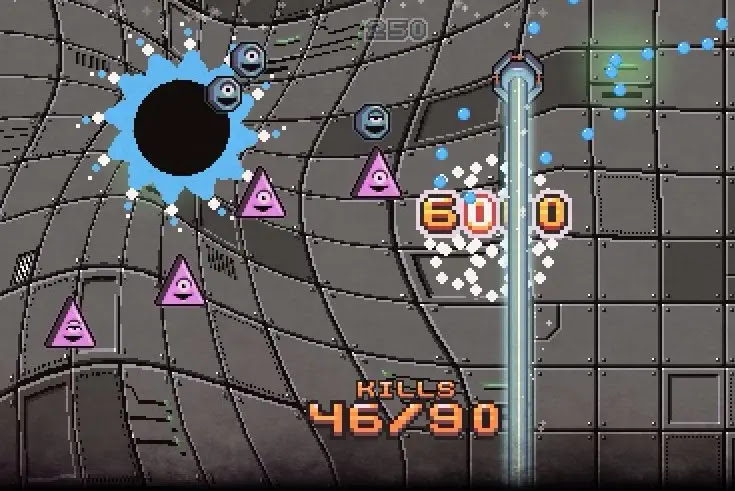
The game plays much like Pacifist mode in Geometry Wars, but
your ship has a tail which can take out enemies. Hitting certain enemies with
the tail can also charge a laser attack. Once a certain number of enemies has
been destroyed, a gateway opens to the next level. One hit and it’s game over,
and that’s it.
Control is imprecise, mostly due to the inertia imposed on
the player’s craft. The tail follows the path of the ship, dishing out damage
on whatever it touches, and there’s a lot to contend with as enemies come in
from all sides, helpfully forewarning the player via an arrow indicating which
edge they’re joining the arena from. Some pre-planning is required in order to
have the ship’s tail waiting for enemies, as one hit will end the game.
Sometimes wormholes open to allow more enemies in, but they can be closed by
circling with your ship. Occasionally you’ll gain the odd power-up, but it’s
just more of the same over and over again, with no draw to pull you back in for
one more go.
The pixel art is nice enough and the music is pretty decent,
but the whole thing feels like it’s trying too hard to win you over with its
style and difficulty. And this is its biggest failing; it just can’t back it up
with the gameplay. The taunting triangle after every game over is more grating
than playful, and the music is limited to a couple of tracks, so can wear over
time.
And that’s basically it. The game feels like a mode within
something larger rather than a game in its own right. It features a couple of
modes and some multiplayer options, but the whole thing feels like an
incomplete thought, and what is there fails to entice the player back for one
more go. All in all, it plays like a half-baked attempt at an arcade score
attack title, but sadly it has no sting in its tail. Perhaps One-Dimensional
Conga Combat would have been more apt as a title.
Monday, 21 August 2023
Testament: The Order of High Human Review (Steam)
Written by Thomas G.J. Sharpe
While I have a fondness for mid-market, smaller scale
titles, Testament falls a little limp in too many places for me to be
able to recommend it. As an action game, it feels light and low on impact. As a
story, I was left a bit underwhelmed too often. The stealth elements are hard
to engage with. The RPG systems a bit arbitrary. Yet, it does have some good,
even great aspects to it. So, I am more sad than incredulous at Testament.
As I try to get my thoughts straight about what Testament
is, it occurs to me that it’s a good demonstration why I feel it falls short. I
should start with things I’m sure of, however, and say that it is a
first-person, action-adventure in a dark fantasy setting. Looking at the
developer, Fairyship Games, website, and the website for Testament itself,
this seems to be an attempt to create a series of games about the land of
Tessara with all these odd moving parts. There’re divine lords, orc-like
humanoids, more recognisable animalia, and strange unnatural aberrations, as
well as different spiritual powers and sects. It washed over me, but it’s
spirited enough and done with some degree of enthusiasm and conviction. It very
rarely, however, made too much sense. You play as Aran (a sort of gruff fallen
angel-lord type; bit earnest, bit vague) who has lost his powers and has been
captured by a talking tree. I felt there might be a creepy woodland vibe for
the whole game, but it shifts about to different locales.
The visuals are great. Not amazingly cohesive, but it has an
atmosphere. There’s a tonne of slick wetness, bloom and brightness going on.
Very flashy use of effects. I enjoyed the dingy caves and manky woods, more
than the temples and mountains. Visually, the GUI and HUD are ugly, and break
the gains of the nice art and design, sadly.
Similarly, the writing plays coy and vague, wasting any good
ideas hiding in the world. Throwing around unestablished lore and
world-building with no context. With little or no connection, sympathy, information,
or motivation to be or help, at least, Aran move forward on his
quest, I hoped to find fun in the gameplay and have the story be a bumbling
side-dish. Your daily bread is first person action, mostly swords and arrows.
These both feel damp and too light when executed and when they land. With
little feedback, it did dirty on some good, fun villain designs. I rarely felt
weight or result of action. Stealth can be employed to clear areas of enemies,
but it becomes a bit of a guessing game with hard to ascertain distances of
awareness and sloppy AI.
A real shock here, for me, was that one of the more
enjoyable parts of Testament were platforming sections. What’s that?
First-person platforming sections? No, I’m not a High Human (yuk yuk). There
are some genuinely creative platforming sections with some interesting
environmental puzzles. No, it doesn’t feel as good as Dying Light or Mirror’s
Edge or something like that, but for a game that has so much spaghetti
thrown at the wall, this one of the bits that has stuck.
Progression is blocked by bosses that what you might expect.
A bigger, tougher version of a mob, or a big creature. These were mostly
frustrating, exposing some of the lack of interaction between stamina, energy,
health, and attack styles systems. The challenge is in the wrong place; rather
than feeling as if I was losing a skill battle, I felt like I’d been given
poorly optimised tools to do the job with.
As I trundled through Testament, I did lose interest
I’m afraid and did fail to finish. A final criticism is the length, which is a
co-morbidity of the pacing of the story. It struggled to move me to investment,
as there was only so long I could be sort of into it. The world looks fun and
there is something lurking back there, but too many dull systems amounted to a
misfire here. I hope that the dev looks to tighten the focus of any future
titles. Testament could have been a quite engaging action story if it
were half the time and markedly less flabby.
Overall 5/10
Monday, 24 July 2023
The Eternal Castle Remastered Review (Switch)
Before the recent cinematic platformer revival The Eternal Castle had already landed on the Switch and the story and mythology behind it is just as intriguing as the game itself. You see, the ‘remastered’ part of the title is a misdirect, there was no Eternal Castle to remake. The idea put forward is that the game is the completion of an uncompleted game from 1987 that developers remember from their youth. In truth, no such game exists and the story is just a legend developed to set the up the context of how the game plays and looks.
The first thing that hits you is the incredible unique style of the game. Initially it is a little eye melting but you’ll soon get used to
the faux retro look and it works perfectly in getting across the feel and environment.
It’s difficult to describe to those who don’t remember games from the time
period the game is supposedly set in but it certainly conjures the memories of
the more ambitious platformers of the time. If you can visualise Another World
running on a BBC Micro with only a few colours being used at once you’ll be in
the right area.
The game plays much in the way we have come to expect from
cinematic platformers. Your character takes extra frames to do things, so you
know you have to make a slight adjustment to jumps and combat but the whole
thing moves in a much more cinematic way. The game is also responsive and
sharp so there isn’t much need to panic if you’ve struggled with these sorts of
titles before. The main causes of death are due to the games difficulty and traps
being hidden in the graphics rather than due to elongated movement.
Though difficult, Eternal Castle isn’t particularly long so
when you hit difficulty spikes you’ll likely want to push through them. After
an initial introduction stage you have the choice of facing the next three
stages in any order. Each stage has a unique look and focuses on different skill
sets. One is a haunted castle which requires sneaking, while another is focused
on using guns for instance. Each contains a string of near-constant set pieces and impressive boss fights at the end. it certainly lives up to the cinematic moniker. Once these have been completed and the parts to
your space craft collected you can then fly off to the final level and
eventually take on the big bad at the end.
In the two-hour runtime the game certainly throws a lot of
variety at you so you’ll always be doing something new. It’s a carefully
crafted game where every minute of it has been considered and set out to provide
a unique experience for the player. The short run time also makes it more likely
that players will return for another run through. There’s certainly plenty of
law and things you may miss the first time as well so it’s well worth diving
back in.
Overall, The Eternal Castle Remastered has both an intriguing
back story and is a great experience in its own right. There isn’t really anything out there like
it, even other cinematic platformers aren’t really the same. Players will
certainly need to take some time getting used to how the game looks and works
but once you do you’ll experience an adventure like no other.
Overall 9/10
Monday, 10 July 2023
Planet of Lana Review (Steam)
Written by Thomas G.J. Sharpe
This short, but well-formed, adventure starts in the titular
Lana’s village. A coastal accretion of shacks and huts, with a population
living out quiet lives. You learn the controls following your sister around and
discover a sad family history. Then, in timely fashion, robo-aliens start
piling through the atmosphere and do a kidnap job on everyone, which the nimble
Lana is able to evade. These charmingly designed robots leave Lana alone, save
for a small black cat-like creature called Mui. This is Limbo and Abe’s
Oddysee for fans of Journey in a Wind-Waker colour palette. I
dunno, the comparisons are still slightly non-functional. I was reminded of Brothers,
obliquely, with the twin dynamics of tragic-adventure and co-operative puzzles.
Lana and Mui work together to traverse the landscape, tame wildlife, and trash
robot invader plans.
Some shots are just for show. The camera pulls out as you
chase Mui down, wider and wider, until there’s a boulder crammed in a leafy
canyon. There’s a tree sticking out of the top. It’s just for effect, played
slow and careful. Lana trudges across a desert, despondent and defeated,
everything lost (but a set up for an exhilarating reversal before the climax).
Wishfully Studios have crafted something that has less vicious edge than its
most obvious ancestors, Limbo and Inside. There was a longing, or
hope against hope, that came to me from the sublime Spiritfarer. Lana is
just capable enough, but there is a lonely and dangerous quality to the
game. In this is my only real gripe, that many of the puzzles were a
frustratingly tightly timed series of actions. If you failed to pull it off,
there was a little long to get back into it, and often some setting up or
pre-positioning that became real old, real fast if you’re stuck. This is
certainly a personal problem, as I have such low patience, and such I am not
docking too many points off Planet of Lana. Most puzzle or platform
players will find this fine to accommodate.
Of particular note is the music. The score is so deftly
handled that there is a real built sense from the small, yet bustling village,
the peace of a forest gravesite, and quiet childhood games, to the soaring
chase scenes, tense stealth sections, and eventual sci-fi battle grandeur. The
compositions are linked with recurring motifs and themes, perfectly placed.
There’s horns and bleeps and pads and all sorts. Just a real joy to experience.
Planet of Lana lasts around three to four hours (I
was closer to four, but after looking playtime up, most did it around three, so
I just suck) and is a taut experience that blends the best of this genre
together. Between its presentation and its gameplay, there is huge value in a
small package. Its core strength is this brevity, as the formula would not, in
this reviewer’s opinion, have lasted to five hours. The push-me-pull-you,
stelf-jump-stelf pattern is deployed for the right amount of time to engage us
in a well-crafted adventure story, and no more. Knowing when to stop is a real
virtue in games. Wishfully have made something special, intimate, yet grand,
that seems to fit in your pocket.
Overall 8/10
Monday, 3 July 2023
Evil Wizard Review (Steam)
Back in the realm of satire, Evil Wizard works hard
to evoke some nostalgia for character pieces. Swimming around in this spirited
but messy game there’s all sorts of things to enjoy for fans of retro games,
ARPGs, metroidvanias and arcade slashers. Evil Wizard comes with a big
ask, however, and if you don’t want an all-encompassing, ever-present satirical
performance, you may struggle to maintain patience. I just about found enough,
in balance, to enjoy a lot of this title, but the gameplay is playing a bit of
second fiddle to the main orchestra of poking fun at games, media, pop culture,
and the like.
I would say that you play as the titular wizard, but
within bare seconds of the introduction the fourth wall is broken and the
player is acknowledged directly. After being defeated by the hero, the wizard
is looking to take back his castle and exact some oft cited “sweet sweet
revenge”. There is, therefore, an odd sense of discovering what the wizard
should already know about his castle as you break back in. This is the only
sense in which this game is similar to the film The Rock.
There are three elements to the gameplay as you progress
through the castle. General combat with enemies, boss fightin’, and
environmental puzzles. Of the three, the most satisfying are the boss battles
because they lean into the strength of Evil Wizard. Enjoyable
characterisation kept the game afloat for me. Finding the different ways each
boss was designed to mock or satirise was a lot of fun, and similarly some of
the NPCs had some great dialogue and crass sensibility. The combat of boss
encounters went on the rumble strip close to the verge of too-frustrating, but
not fatally. The environmental puzzles, similarly, have a nearly-too-simple
feel that strips back a lot of the gameplay experience to something a bit more
passive than I’d like.
General hack-n-slashin’ in Evil Wizard lacks a depth,
or maybe a heaviness. I felt the movement skatey, but functional. There is a
lack of connection between the wizard and the world, in a “physical” sense,
which causes a floaty feeling.
While some enemies are nicely conceived, there was a bit of
a repetitive vibe, and you’ll see familiar faces a lot. Abilities and moves,
items and weapons all are present but again are in service for the atmosphere
rather than a great playing game. A lot of these elements feel like
opportunities for gags than developing play experiences.
Where Evil Wizard works is in presentation. The
artwork is charming as hell. It is bold, well executed, yet detailed and
subtle. The animations are cracking, and the lighting effects set everything
off. The utility animations for GUI and game signals are really solid too, with
lots of dynamism and zing to help the screen stay active. Visually, this for me
was somewhere between Zombies Ate My Neighbors and Dungeon Keeper.
I like the blocky, yet nuanced pixel work so much that I resented it when the
game zoomed out for sections. The other part that I cannot skip over is the
music. This is pitch-perfect stuff that evokes some real old time Sierra games
vibes.
The drop in rating for me is simply the uninspiring combat,
as it drags the whole effect down. It is a tough game and can get tense when
you’re trying to execute finishers as a way to bolster your health, but most of
the time just lacks the punch I expect from something predominantly arcadey-fighty.
Placed next to the clear creative zeal of the developer for the presentation of
the game, it is a shame to mark it back. This sort of crass fun is very welcome
in my world, and I think games that satirise games are a welcome relief, but I
hope the developer ups the ante for a more robust gameplay experience to match
a clear talent with artistry.
Overall 6/10
Monday, 8 May 2023
Lunark Review (Switch)
Written by Thomas G.J. Sharpe
As cinematic platformers are on the re-ascendant it is
heartening to me to see a developer making the case for the vital fibres of the
genre. Flashback, Prince of Persia, and Abe’s Oddysee are
all sort of the organs of Lunark, and it works out like a great slice of
uncompromising pie.
The scene of this CINEMATIC platformer is sadly the weakest
part of Lunark. The story is Deus Ex: Human Revolution adapted
for a 90’s Saturday morning children’s cartoon. You play Leo, who is a peppy
courier with a slight otherness to him, marking him against the human
characters (like Jensen’s nano-guts), who has his very own guiding tech-mentor
Gideon (like the fella with the office and the goatee). Things go chaotic at
Gideon’s robot factory, however, and Leo is going to have to find out who’s
behind it all. There are many locations to visit from futuristic city skylines
to dank caverns, with a fun conspiracy narrative that won’t stretch your brain
too much.
Rather than a beige-yellow-black cyberpunk murk, however,
there are colours and adventure and boldness to Lunarks design. Having
said that, there is a bit of a spattering of design styles on show here, which
is jarring. There is beautiful, serious rotoscope cinematics (a la Flashback),
with bold and blocky character portraits that take many styles. The occasional
3D model, lovingly frosted into abrasively large pixel form, work well, while
some characters seem too small to make sense of. It is an odd presentation that
I never quite got on with, but I do like the boldness of this game’s look.
To keep track; bold presentation, meek writing. So, the
gameplay has to make up the mark and then some. And it does, for me. Lacking
the fluidity of Conrad’s movements in Flashback, Leo is more noticeably
taking a slot at a time on the ground. There is a plodding, but via this,
thoughtful pace. Each little section can be tackled like a sequence of
movements and actions that, if you get wrong, you soon learn costs you quite
dearly. I bucked my ideas up and paid attention to jumps, ledges, enemy
patterns, and obstacles, after Leo kept meeting his demise. At times this can
feel quite punishing due to the distance of respawn points varying from quite
close to too-far-to-be-enjoyable. You’ll get into the groove, or you’ll bounce
off, probably, as the story isn’t quite compelling enough to drive it alone.
Combat is inevitably pulled into this steadier flow too, where you have to fall
into view of a drone or wee monster at the right time to get to cover, or get
your shots off. There is a lot of timing and a lot of learning which movement
keys to get in the right time, and during which cycle of movement. The
difficulty curve isn’t that steep, but make sure you take your time.
I ended up enjoying the considered pace. There are very mild
collectible-side-quest-NPC gewgaws to indulge in. The fact there was such a
small amount of these felt like a song from a simpler time (I am currently
playing through all the Assassin’s Creed games, so I’m generating a deep
hatred for any collectible clutter like some gaming Marie Kondo). In fact, all
of Lunark speaks from a different place. There is a lack of cynicism, a
straight-forwardness, and a clarity of purpose that works. This is a tight and
specific game, that speaks to an older time.
Much like point and click adventure games spawned new game
types, the cinematic platformer was eaten by its own offspring (see Fade to
Black) that pushed for greater excitement, embraced new visual angles, and
sped up and up. These two genres are seeing a resurgence at the moment, and Lunark
holds a particular spot with an entertaining game, that serves both something
old and something new confidently and with a keen sense of joy.
Overall 8/10
Wednesday, 29 March 2023
Legends of Kingdom Rush Review (Steam)
Written by Thomas G.J. Sharpe
I recall a period of time I spent unemployed and found myself on Newgrounds playing Ironhide’s flagship series Kingdom Rush. I know some stand by Bloons TD, but the best tower defence for me was Kingdom Rush. I whiled away the expanses of a few days between job applications and the inevitable wall of silence that prospective employers feel entitled to supply. The light-hearted world building, comic cutscenes, and accessible learning curve scratched all the itches. It was good casual gaming done with style. Ironhide have started to branch out into new territory after testing a non-fantasy setting with Iron Marines, a “casual RTS” as they put it. With a follow-up to this and some sort of post-apocalyptic, Mad Max-type title coming out, the towers seem to be receding into the background.
Legends of Kingdom Rush is set in the world of KR
but is a strategy roguelite that takes an X-Com angle on it’s gameplay.
While fun and seated firmly in all the trappings of what we can expect now from
Ironhide in the way of tone, aesthetic, fun, and accessibility, LoKR
falls slightly shorter than the good times of the tower defence titles. A hard
standard to maintain, if I’ll be honest, and the Steam reviews do reflect that
this hasn’t quite hit the same mark.
With a light, story that lines each run, you accrue a motley
band of familiar heroes to fight the current evil of the day, encountering
different events along the adventure. Sort of like the things you’d meet on the
road in the euphoric silliness of Death Road to Canada. Do I want to
rest at the campfire or search the area? Go fishing or tell a story. That sort
of thing. As expected, there isn’t the depth of the encounters of Darkest
Dungeon, but the characters till develop and level up as you go. It is an
enjoyable process to customise these heroes, and it isn’t overwhelming. None of
LoKR is, and this is a strength, broadly speaking.
The combat, between encounters, makes up much of the game.
Little hex-arenas that pit your squad against some wee beasties and some
not-so-wee beasties. The learning curve is ok, the difficulty is just ahead of
you. Using your various spells from mages, cleaving strikes from knights, and
volleys of arrows, you must consider positioning, thinking (a bit) ahead, and
item usage to survive the day.
The first knock against this is the sheer amount of time the
runs take. I almost would have preferred a full little RPG-lite, rather than a
roguelite system. The characters are enjoyable and well-written enough to carry
something like that, I would offer. Further, once you start to realise that
certain playstyles expose a lack of balance, the scope to want to try other
combinations feels a bit uninviting. A couple of goes through, I’d settled into
what I learned to be a bit of a cheesy strategy, and this always feels
underwhelming. I just didn’t really have much desire to go back to it, however
much I enjoyed it.
The developer, however, is up-front with players about being
a primarily a non-desktop, casual and accessible game. I read some opinions of
the GUI being quite clunky on desktops, and I must say that this was on my
mind, but certainly wasn’t game breaking for me. I’ve always quite enjoyed
Ironhide’s big clunky buttons, but perhaps there are some inelegancies to the
clicking you have to do.
All in all, I enjoyed LoKR, but I think not for as
long as the game was designed to be enjoyed for. I’m going to mark this one
down, for myself, as an interesting foray into another bit of KR-world
fun, but one that I won’t return to over KR tower defence titles. This
may land better with more patient players, however, and especially those who
are looking for a touch more of the gorgeous comicky world filled with detail
and joy.
Overall 6/10
Wednesday, 22 March 2023
Sokobos Review (Steam)
By Thomas G.J. Sharpe
Most Sokoban puzzles can be stripped down to the
simple format of shove item in right order, but various mutations have appeared
in the genre since it’s first incarnations. A reasonable assumption is that the
inspiration for Sokoban would be a sliding or tile puzzle, but changing
properties of items is something that extends the formula from it’s non-digital
roots. Sokobos has colour-changin’, water-crossin’, far-travellin’, and
even tellin’ a story, while its all going on. This is a neat package that is
bigger than it appears, challenging (I own that I am terrible at these sorts of
games), and feels satisfying. Most significantly, the feel of moving Aeschylus
(your character) around has more connection than a casual-retro puzzler it may
appear. There are some fun feedbacks with screen shakes, effective audio, and a
great soundtrack. The writing is strange, bleak, and poignant. I don’t know how
the story ends (as I do not have the abilities to finish this), but the use of
a classic Greek tragedian as the protagonist gives some idea of the tone of Sokobos.
I got sort of connected to the world and it’s dream-like, void-y atmosphere.
There is almost the shards of threat, or something sinister wrapping everything
together.
For dedicated puzzle fans, this could be either just too
familiar or just the ticket, I’m not sure. Not being a frequent visitor of the
pushing-blocks around scene, there was enough to keep me engaged, but was too
frustrating for me to last. I’ve looked longingly at games like Escape Goat,
for example, and wished myself more patience. I found the process much like a
Sudoku, in that it is a process of elimination that had vastly more routes to
eliminate. Sokobos hits enough of a mark to have an impression on its
non-target audience, but did eventually bounce off. An interesting and
effective little game, if you’re down with that sort of thing.
Overall 6/10
Wednesday, 8 March 2023
IXION Review (Steam)
Written Thomas G.J. Sharpe
In recent years, I’ve read more sci-fi and, in my head, the
aesthetic that is closest is stuff from The Expanse or Alien or IXION.
I like this robust and lived-in vision than the clean lines and pearlescent
wonder of a more magical cosmic design. IXION wants me to know that I’m
at the coalface; the administrator of a colonising space ship called the
Tiqqun. A big metal donut that is meant to be forging the path toward a new
planet for humankind to ruin afresh. Before the big interstellar jump (that
goes wrong and initiates the main thrust of the story), you are tutorialised by
building structures on the ship. Why the Tiqqun was not constructed properly on
Earth before launch seems to indicate to me some reasons why the jump engine
caused a solar-system wide cataclysmic event. I do not need clumsy Greek names
for menacing corporations to tell a cowboy builder.
Trying to draw on some of the social elements of things like
The Expanse, perhaps, there is now a focus on keeping your workers happy
in the new, changed, solar system where most life and planets have been reduced
to devastated baubles. You require workshops, eateries, residential buildings,
service ships, stock piles, and so on, and so on. A tech tree expands your
building options, and prospects of occupying other parts of the Tiqqun (again,
I have no clue why this ship was not finished before they sent it out as the
vanguard of humankind’s final hope).
You settle very quickly into a whack-a-mole problem solving
balancing act, which is (in my humble opinion) what a well designed
colony-sim/management game should not feel like, even if it is. Frostpunk
has an elegant groove it slots into and drives the point home to a crushing
climax. Tropico is a careful nurturing of balances. Workers and
Resources makes you enrol in Excel courses. IXION puts on a good
show, throws a lot of moves, but in the end I felt little of the joy that I get
from those other (similar-ish) titles. And I so desperately want to enjoy the
gameplay more than I did, as the world looks and sounds so good (bar the
pedestrian/robot traffic). It seeps and oozes atmosphere, dread and abandonment
to the brutality of space. Sadly, I spent more of my time trying to wrestle
with poor design choices that I made out of necessity and then am punished for.
I ended up resenting the population of my little metal life raft for humanity.
My first impression was that this would be if some grand
sci-fi opera writer did a version of Startopia, the criminally good
space station sim. Some de-flabbing of the unfun gameplay systems would’ve
served this beautiful looking, but slightly charmless, title better. Nearly a
three out of five, so maybe I’ve some personal disappointment going on as I
wanted to like it more. Not the worst space management, but unfortunately, not
the best either.
Overall 4/10
Monday, 6 March 2023
Rogue Legacy 2 Review (Switch)
Way back in 2013 we got our first take of Rogue Legacy. Now,
some ten years later the sequel has appeared so it seemed we ought to dive into
the ever changing castle once more and see how it holds up. It’s still very
much a randomly generating and highly difficult game of exploration, loot and
beasties. And who would want it any other way?
Right from the start it’s clear that Rogue Legacy has much
more going on than many of the other Rogue-like games of recent times. You
start off with your hero entering a castle from a 2D, side on perspective and
then proceed to hunt around for treasure and the boss monsters that guard each
area. When you die your offspring must then take up the reigns and continue the
search.
The continual line of offspring randomly generate into a
number of predetermined classes. There are mages, knights, lancers and others
which can then be expanded out into more specialist explorers such as the gunner
and assassin. Each class has its own strengths and weaknesses and different
weapons and traits that it uses.
You get to pick from three randomly created characters at
the start of each adventure and these can be in any of the classes you have
unlocked so far. Each individual then also has traits which give them their own
strengths and weaknesses. There are a massive amount of different traits and
these range from things like Gigantism (makes your character bigger), to
dyslexia (can’t read signs) and things such as having an affinity with magic or
boosting your speed. There’s no real way to know what you’re going to get so
you need to adjust your play style accordingly.
Everything in terms of unlocking or levelling is done with
the gold you find around the castle. This can be used to up your stats, buy new
equipment or unlock the specialist classes. Upon your death any money or
equipment you have is passed onto your next character to use and spend. The
kicker is that any money left over after upgrading then needs to be given to
the ferryman in order to be let back in. This can create a cycle of not getting
very far as you don’t quite find enough to upgrade while being out matched by
the difficulty.
Rogue Legacy 2 is certainly not here to treat players with
kid gloves. It takes a good few hours to get to grips with and to actually feel
like you making progress. Unlike the first game, gold is not the only way to
level up so at least you will get something for the all the monster bashing
being done. Certain objects and unlocks stay in place as well so while progress
can be slow it will come with persistence. There is also a massive amount of tinkering
you can do with the ‘house rules’ if you find yourself hitting s brick wall.
This allows players to change health, damage and many other things to help make
progress easier – should you wish.
Though the castle is randomly generated you can use the
architect to lock it down. For the price of a percentage of your gold this
keeps the room layout the same and allows you to use the teleport squares you
may have found to get you right back into the action. The main benefit of this
is when you discover a boss. Bosses are fierce and difficult and will require a
number of goes to get the better of. If you decide you character is strong
enough then getting the castle locked down allows for repeated characters to
simply teleport right to them for another go. Once a boss is downed they stay
dead for good.
It’s fair to say this isn’t going to be a game for everyone.
It very tough, especially at the beginning and you will need to sink a load of
time into it to get you to a point where you feel safe to explore properly. Alternatively,
you can of course play around with the house rules. Once you level up a bit and
get used to the game it really does start to get going and you’ll be
continually drawn back for more. However, many gamers might not make it that
far and that’s a shame as this is probably one of the more inventive games of
it’s type.
Approach it patiently and with the knowledge that you are
going to die and it offers an experience among the best in the genre. It’s a
must for fans of the Roguelikes but the more casual gamer should probably get
their kicks with something a little easier to handle.
8/10
Monday, 30 January 2023
The Excavation of Hob's Barrow Review (Switch)
You play as Thomasina Bateman, a barrow archaeologist whose skepticism drives much of the story forward. Much seems to be reminiscent of Lovecraft here; a protagonist who is steadfast in a no-nonsense scientific empiricism, slowly broken down by the relentless inexplicability of other-worldly horror. There is also something similar to Lovecraft’s The Colour Out of Space here; a subterranean mystery that has seeped up to the surface to ruin lives and challenge sense. To describe Thomasina in more relevant terms, she felt like a wonderful, charismatic mash-up of both Indiana Jones and Sophia Hapgood from The Fate of Atlantis. Through her, you interact with a bevy of Derbyshire (presumably) characters. A luddite local resistant to the new railway connection; a sad but well-meaning drunk somewhat lost in his own tangled memories; a chirpy, unconcerned barman; a stoic, restrained blacksmith. They’re all fully voiced superbly and uniquely, especially notable as it is largely a Yorkshire accent being used.
Thomasina’s arrival in the town, with this population of variously mysterious individuals, is spurred on by an invitation to excavate Hob’s Barrow. The farmer on who’s land it is situated, however, won’t grant you permission to dig it up. This, amongst many other obstacles, must be overcome to reveal the story. The locations are vivid, in a classic style. Especially noteworthy is the town square at night, which aches and creaks with atmosphere, with the fog fighting the glow from the pub’s window. Navigation across the locations is easy and accessible, as is all the user-interface. There’s even a fast-travel system, which is quite fortuitous as some progress is made really by checking out all the locations to see if something has changed. This is one of my few gripes with Hob’s Barrow, as I felt like I needed to run the list of places rather than solve anything. The developers do emphasise that this is a narrative-driven adventure, so I understand that the puzzlin’ might be a bit “lite” for some.
Much of the point and click puzzling is immediately quite straightforward. If you have the items, they are rational and fitting solutions which drive the plot forward. I never felt like I was doing something absurd (aside from the more supernatural settings, where it is understandably reality-bending). I had a couple of stumbling blocks, but it turned out I just hadn’t checked out an area.
Barrow is a short game but has enough time and space to do what it needs to. You may well spot the trajectory of some of the story beats if you’re familiar with folk horror, or creepy Victorian stuff, but despite its clear influences, the journey to the outcomes is really something special. The time spent in the dialogues is a joy, the music is eerie, the cutscenes are sublimely weird, and there are just enough puzzles to keep you engaged.
I have since found some more work by the developer that I can’t wait to play. While I would have loved to have had a deeper point and click experience, this just speaks to how much I loved being in the village of Bewlay with Thomasina. The attention given to some folklore is brilliant, and there is even a goat that felt like a nod to Broken Sword. At the close of the game, I was hoping that Cloak and Dagger Games make some sort of point and click version of Turn of the Screw or Hardy’s Desperate Remedies. They’ve got the eye for this sort of atmosphere, and I can’t wait for the next one.
Overall 8/10