Bitmap Books

Showing posts with label Nintendo 3DS. Show all posts

Monday, 7 December 2015

Dragon Quest: The Zenithia Trilogy Review (DS)


The Dragon Quest games have always been in the shadow of other RPG’s in the West due to rarely being released outside of their homeland. Dragon Quest VIII did make it across on the PS2 and garnered enough interest for Square-Enix to consider releasing their back catalogue. From 2008 to 2011 Dragon Quest IV, V and VI were remade for the Nintendo DS. Collectively known as the ‘Zenithia Trilogy’ (The name of the castle in the sky found in each game), they were renamed as ‘The Chapters of the Chosen’, ‘The Hand of the Heavenly Bride’ and ‘Realms of Reverie’ respectively.

Each of the three games is fairly similar in terms of core mechanics. Combat is turn based with party members having the option to attack, defend, use items or flee. Four party members can be used at once with others being able to be swapped in and out to allow the player to configure different types of configuration. Combat is initiated through random encounters as your party travels around dungeons and the world map

There’s nothing particularly complex to learn and the games represent a good starting point for gamers who want to get into RPG’s for the first time. They are also quite forgiving with death as players will find themselves back at the last save point they visited when they die with any experience points they have earned intact – though your gold will be halved. This means that you are never really losing any progress and if you stick at it long enough you will eventually overcome any obstacles. It’s a system that works well as it never punishes the player severely for pushing forward or exploring.

The stories of the games are based around the idea that a great evil is awakening and a nameless hero will eventually vanquish it. This involves traveling the world and finding sacred weapons and armour which allows entry to Zenithia. You will then be able to access the underworld where the evil awaits to be defeated.

There are of course differences between the games and they each have their own way of telling the tale and offer up different gimmicks to keep things interesting. ‘Chapters of the Chosen’ is split into five chapters with the player experiencing the story of different party members as they find their way to the hero. The fifth chapter then puts the group together for the final battle. An extra chapter becomes available after completion which furthers the story and allows a new character to join the party.  There is also a town building sub-game where players can persuade villagers to move to their town. However, this requires some input from other players via sharing which will be difficult now.

‘Then Hand of the Heavenly Bride’ follows the Hero through three stages of his life as he grows up. You will also pick a wife and your eventual child will also join the quest. Monsters can also be recruited to the party and players can find and display various knick-knacks that have been collected from around the world. 

‘Realms of Reverie’ changes things up a bit by giving players the ability to train their party in a wide range of different roles. It’s a similar job system to something like Final Fantasy III and alters the characters core stats and gives the unique learned abilities to them. Once a certain job has been completed more advanced vocations can be taken on which lead to some very useful tools for players to play with. Monsters can no longer be recruited at random by there are a host of slimes to be found in the world who you can talk to and get to join your party. There’s a dragon hidden away somewhere as well. There’s also a slim combat arena and fashion parade to get involved with if you so wish.

All the games contain the same visual style, shops and enemies. There is a church to save your game and resurrect party members, the inn, casino and various shops which serve the same purpose throughout the series. There are also wells which can be looked into and the mini-medals to be found which can be taken to a specific castle and exchanged for rare prizes.

Each of the games is focused on its main story and though there are things like building the town and slime arena there isn’t much out in the world in terms of real side quests. This is generally ok as each town you visit tends to be different from the last and the games move along at a pretty good pace. Each game takes around forty hours to complete and each then gives extra content like dungeons after completions for players to dive back into.

Overall, the three games in the series are pretty much all on a par in terms of their quality. They each offer up a solid adventure which has some good and bad moments as you go along. All the games are great for both newcomers and hard-core RPG fans and they all have great localisations with accents and humour coming through perfectly. If it’s a traditional RPG that you want then the three games here should offer up more than enough to keep you interested.

Overall –
Dragon Quest IV: The Chapters of the Chosen 8/10
Dragon Quest V: The Hand of the Heavenly Bride 8/10
Dragon Quest VI: Realms of Reverie 8/10

Wednesday, 11 November 2015

3D Gunstar Heroes Review (3DS)


As bizarre plots go, Gunstar Heroes is classic 16-bit era madness. You are in charge of protecting planet G9 from Colonel Red who to resurrect a huge robot named Golden Silver and then take over the planet. To stop this Professor White has hidden the four mystical gems that control the robot, but they won't stay hidden for long because with the help of Green (a Gunstar brother who Red has kidnapped), the Colonel will soon close in on the robot's power source.

What the plot amounts to is a number of side-scrolling, action-packed levels with lots of jumping sliding, diving and shooting for One or two players. Each level presents something new - one minute you might be running along quite happily, guns ablazing, and the next you might be sliding down the side of a mountain, or falling headlong into a futuristic mine cart, with your balance swapped between floor and ceiling. The game keeps you on your toes and the pace never lets up for a minute. It's an exhilarating ride.

Graphically, Gunstar is set in a sort of crazy Anime-inspired cartoon world. The emphasis is on big explosions and unleashing as much colour and movement as possible. It's hard to imagine how the Mega Drive coped with all the action and now it's running even more smoothly on the 3DS. Levels invariably finish with a number of manic boss battles with each monstrosity proving stranger than the last and generally filling half of the screen. In keeping with Treasure's standards, everything animates and disintegrates wonderfully and at the time this was about as good as it got on the Mega Drive in terms of the sheer amount of effects.

Much like the other side scrolling games that have made the move to the 3D Classic series there is nothing amazing in the 3D effect. There's some nice scaling and rotation but the game looks equally impressive just zipping along without the effect on. The now standard options for changing between the Mega Drive or Mega Drive II for emulation and having the Japanese and International versions available are also found here. The biggest addition to this version is a new mode which lets you cycle through all the available weapons instead of being reliant on the weapon drops.

Pure quality of presentation aside, the gameplay of Gunstar Heroes is every bit as good. With so much happening at any one time, it is essential to have a responsive and flexible control system. The game allows you to customise your shooting method - it can either be set up to fire while the player is moving, in the direction that the player is moving, or it can be fixed in one direction while you leap around in another. Additionally, our heroes can rely on a few other moves to avoid enemy fire; you can slide under obstacles, jump up to higher levels from below, and somersault off the walls, damaging anything and everything upon your descent. It's fluid and responsive action, and exactly what you need when you find yourself stuck in the middle of increasingly tight situations and set-pieces. 

Overall, Gunstar Heroes is an exceptional title. It looks great, it plays better and even the sound is orchestrated to make everything as hectic and adrenaline-pumping as possible. If there is a fault to be found, you could say that the game is perhaps a little too easy, given its straightforward design. But the two-player consolation ramps up replay ability, and even now the remit has hardly dated at all - meaning it is just as enjoyable and playable as it was upon release. Highly sought after (and rightfully so), Gunstar Heroes proves just how blisteringly good Treasure are

Overall 9/10 

Colour Blind Issues - No
Review Code - Yes 


Wednesday, 21 October 2015

3D Sonic the Hedgehog 2 Review (3DS)


The Sega 3D classics range has proved popular so far and it was only a matter of time before its number one mascot returned to the 3DS with what is arguably the blue speedster’s best game. Sonic 2 has long been heralded as one of the greatest platformers and though we personally never got on with it that well we were more than happy to give it another go.

The 3D version of the game comes with the now standard features we have come to expect. You can run the Japanese or world versions, emulate it on the Megadrive or Megadrive 2 and set the 3D effect to pop in or pop out of the screen. Along with this you can save and load at any time- even when your last continue has been used.

You can now also put the game into a level select mode where you can simply try out any stage you want at any time. This includes the pseudo 3D bonus stage which will run through its various rounds as you zoom down a tunnel collecting rings. The only thing really missing is being able to access the Sonic and Knuckles content which is unlocked when adding the game to the aforementioned cartridge. This is a shame but we wait to see what happens with the classics series in the future and what Sega has up their sleeves in this respect. The restored level from the iOS version is also missing.

As Sonic 2 is mainly a 2D side scrolling the game the 3D effect doesn’t really add much to it. We quickly turned it off and felt it was more a novelty than something that has elevated other classics such as Space Harrier and Out Run. Even the 3D bonus stage didn’t really come alive with the effect on which is a bit of a missed opportunity. The other minor grumble is that the colours seem a little bit off from the original version. At times some of the stages look a little washed out with the graphics not as vibrant as before.

That said, this is the most fun we have had with Sonic 2. This time around the tight level design and well balanced challenge seemed to fit the 3DS perfectly and we were more than happy to zoom through it in one setting. 

There are quite a lot of zones to get into and each one has its own thing that makes it unique and different from the last. One minute you’ll be bouncing around a giant pinball machine while another stage will see you trying not to drown in a forest or avoiding oil spills on a giant rig. It has the right amount of challenge while still remaining fun and inventive and the boss fights are also set just about right. There’s plenty to see as well as most levels have multiple routes through and contain more than enough secrets to keep you occupied and returning for another play through.

Minor issues aside what you effectively have here is the definitive version of a 16-bit classic platformer. There’s nothing here to convert people who never really got into Sonic but if you have never played it before or are a returning fan then you are going to love it as all the magic remains. In a world of indie 2D platformers this still stands head and shoulders above pretty much all of them.

Overall 9/10

Friday, 18 September 2015

Kirby: Triple Deluxe Review (3DS)


As always with games starring the pink vacuum, Kirby Triple Deluxe arrived in Europe with little fanfare. This is a really shame as it certainly is a game worth shouting about. Comprising of a platform adventure and a handful of mini game modes this is arguably Kirby’s best ever outing. It’s also one of the most fun games in the 3DS library.

The story goes that one night a giant bean stalk starts growing in dreamland. When Kirby wakes up he finds himself in the sky land of Floralia and that King Dedede has been kidnapped by weird creature by the name of Taranza. Kirby sets out to save the day and find out exactly what all this means for Dreamland.

Recently, each Kirby game has offered up its own unique gimmick. We had the small puzzle like sections in Mouse Attack and the multiple Kirbys in Mass Attack and now there is the super ultra-vacuum ability that sends Kirby rainbow coloured and allows him to consume just about everything in his path. Huge creatures, bits of the level and even energy bars are not safe as the super hoover sucks its path of destruction. 

This is the most traditional Kirby platformer for a while and there are now around twenty abilities to copy from swallowing enemies. These include the new beetle ability that lets you slam enemies into the ground and the return of the super speedy wheel. Throughout the game there are a number of sections which make use of certain abilities and it keeps things varied and fun throughout.

Though it does take a little while to find its stride the level design is excellent. Along with making use of the different abilities there are also puzzles to solve and a fair amount of use is made of functions such as tilting the 3DS. You won’t be tapping away at the screen but what is here is implemented well and never outstays its welcome. Triple Deluxe also displays some of the best 3D effects on the system with a host of things (including Kirby), flying in, out and around the screen at every opportunity. In fact, we would recommend keeping the 3D slider up as things come at you on different layers and it can be difficult to tell what’s dangerous to you without it on.

Aside from the exceptional use of the 3D effect the graphical look of the game is of a high standard throughout. It remains in the colourful Kirby style while also showcasing a range of environments in the new Dreamstalk world. The sound is equally excellent with the music setting the scene perfectly and there’s never any doubt you are firmly in a Kirby world.

Aside from simply completing the levels there are also a host of things to find. The most crucial of these are sunstones as a certain amount are required in each world to access the boss battle at the end. Though we generally hate being forced to replay levels there was only one occasion when we reached the end of the world without enough stones to unlock the boss. The other collectables are keyrings which depict various characters from the history of the series. They don’t do anything in terms of gameplay but if you are of an obsessive nature there are more than enough to collect to keep you busy.

Kirby games have never been known for their difficulty and there is no change here. It’s certainly not pathetically easy but we didn’t die that often during our journey through the six worlds. You’ll have to be careful and some of the bosses put up a decent fight but it won’t stop a seasoned player for long. This isn’t really a major issue as the game remains fun throughout and there are enough extras to keep you busy. Completing the game unlocks a mode where you can then speed run it with King Dedede for instance and a boss gauntlet also becomes available which offers up a tougher final boss and extra cut scene as reward for completion.

Aside from the main game and unlockables there are two mini games included to make up the Triple Deluxe package. Kirby fighters is a Smash Brothers-like game where different ability Kirbys fight each other in a series of one on one matches. The second is a rhythm action game called King Dedede’s Drum Dash. Here you have to hit buttons to the beat to make Dedede jump and clap to the rhythm of various Kirby tunes as he makes his way through a level. Both games are great fun and Drum Dash is dangerously addictive.

Overall, Kirby Triple Deluxe is an imaginative and fun package comprising of an excellent main adventure and some fun and inventive mini games. It’s always throwing something new at you and there are plenty of things to unlock and find. If you’ve never really got on with Kirby games before then this could well be the one to change your mind. If you don’t find yourself having fun with the great design and smiling at all the little touches of humour then there’s really no hope for you.

Overall 8/10

Monday, 3 August 2015

3D Streets of Rage 2 Review (3DS)


The Sega 3D classics range has offered us up some excellent revisions of games from the companies golden era. So far the games that run ‘into’ the screen such as Outrun and Space Harrier have come out on top but there’s no denying that Streets of Rage 2 is a genre and generation highlight so even if the 3D effect didn’t add much then we were more than happy to dive into this.

Streets of Rage 2 is a classic scrolling beat’em up in the vein of Double Dragon or Final Fight. You can pick from four characters who differ in terms of speed, power, jumping ability and throws and then take on eight stages where colourful goons with silly names line up to be knocked out. It is a defining game for the 16 bit era and on the Mega Drive this is the pinnacle of the genre. It’s only real rival of the time was Final Fight but as the SNES version of the game lacked a character and the 2 player mode this is really as good as it gets on the home consoles of this time.

You get a fairly decent amount of moves to use with a punch/kick combination, several throws a super move (which depletes some energy), and the odd hidden special attack. Lack of moves is what always leads to the feeling of repetition in games of this kind but there is enough variety in enemy type and location to ward off the feeling longer than in pretty much any other game of the time. The level design is particularly imaginative in places and certainly raises the game up a level past the Rival Turfs of this world.

In terms of what has been added someone has clearly tried to make this as definitive as it can be. You can play around with a host of different options such changing the lives and difficulty of the game. There are also options to change the version of the game from the International one to the Japanese ‘Bare Knuckle’ version, a casual mode and the ability to change the screen to mimic an old arcade machine. You can even change how the sound is emulated if you prefer the Mega Drive 2 to the Mega Drive 1.

Upon completion of the game you get a few new modes to play with as well. One lets you kill everything in one punch while the more interesting unlockable is a mode that gives you one life with each of the four characters to try and get through the game with. 

It’s bursting at the seams with content and the 3D effect actually works as well (and you even get to choose if you want the effect to pop in or pop out). A big criticism of these types of game is that you can’t tell which level enemies are moving on. If you turn on the 3D effect this is no longer a problem and makes the game much fairer as you aren’t hitting air shots.

Overall, this is the best possible revision of Streets of Rage 2 we can imagine. There’s so much to play around with that fans of the original game will love it. There’s a lot of fun for newcomers as well with the only real criticism being that characters can be a little slow when walking around. It’s the definitive version of a generational classic and you’d be mad not to give it a look.

Overall 9/10

Wednesday, 27 May 2015

3D Thunder Blade Review (3DS)


Sega’s 3D classic range continues at pace with its helicopter based arcade game the next to get the makeover treatment. Thunder Blade has always struggled for a decent home conversion and now we have yet another definitive version of the game. Whether that is enough is another matter entirely.

Thunder Blade is a mix of top down and into the screen 3D sections. Both look rather good with the 3D effect on but it can be very difficult to take everything in when you are being pummelled by incoming fire. 

There are only four levels which break down into three or four sections each. Each section requires the constant firing of guns and missiles to take out enemy tanks and jets and you’ll also need to keep your eyes open for scenery to avoid. The 3D effect does an excellent job in the top down sections of giving depth to the scenery so at least you can tell if you are about to fly into a building or not.

When flying into the screen it can all get a bit too much. You’ll need to weave in and out of obstacles and also avoid enemies crashing into you. These sections can be very frustrating as it’s difficult enough to move out of the way of gun fire without having to worry about a fighter jet you couldn’t even see flying straight into you. After this you move to take on a large boss which requires hovering over slowly while you blast away at its guns.

There are only four relatively short stages to get through and with a healthy amount of continues  and a level select it’s likely you’ll whizz through everything on sheer willpower alone. There isn’t that much replay value either as aside from a new arranged mode which adds a section and moves a few things around you’ll feel you have seen everything the game has to offer.

Thunder Blade’s biggest problem is that it was never up to the standard of many other of the games in the 3D classics range even when it was first released. It’s both short and frustrating, but then it always was. This is certainly the best version of the game out there (and it now plays as well as you probably remembering it doing in arcade), but it’s still not that great.

Overall, 3D Thunder Blade will likely be something that fans of the original will enjoy in short bursts. But there isn’t really much here in truth. It’s a good technical achievement but once you’ve run through the game you’ll likely have little impetus to do it again and that’ll take you all of ten minutes. It’s nice to see it get another hurrah (and we’ll certainly never be returning to the Amstrad version), but we’ll be sticking with 3D Outrun for our 3D classics fun.

Overall 5/10

Monday, 30 March 2015

3D Out Run Review


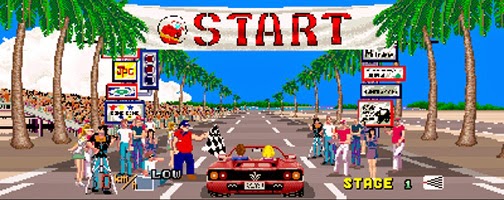
For many a retro gamer mentioning Out Run conjures up memories of racing at high speed through a host of idyllic locations in a Ferrari. There have been numerous remakes over the years but only the Xbox version in 2004 really managed to capture that spirit of freedom and speed that the original had. That’s all about to change as this could well be the definitive version of Sega’s much loved classic.

For those not familiar with Out Run – the goal is to race through the stages against the clock while avoiding traffic and other obstacles. There are multiple routes that can be taken and up to five possible final roads to travel down should you reach the last stage. Hitting traffic slows you down, while hitting obstacles at speed can flip and roll the car causing the driver and his blond passenger to fall out and eat up much needed time. 

Though fairly simplistic at heart – it can also be tough to complete at times. You have a high and low gear to help control your speed but sometimes those corners come out of nowhere and you’ll be flipping into the nearest corn field. Luckily for us the controls are wonderfully responsive so anytime you do find yourself viewing the brutal crash animations you know it’s your fault. It’s about speed and control and if things get too tough (or easy), you can alter the difficulty and your time allowance in the options menu. 

This is a conversion of the arcade game so you are getting the original experience with some nice enhancements. The two most obvious of these are the framerate and new 3D effect. The framerate has been bumped up to 60FPS which makes everything zoom by at breakneck speed and certainly captures the thrill the original game had upon first release. The 3D effect is also impressive and really adds to the experience. These two additions coupled with the classic graphical style really help to elevate the game and it makes everything a whole lot of fun.

There are a few other things thrown in as well such as some new songs and the ability to track your times and scores on each course. It all shows that a fair amount of care and attention has been put into this and someone clearly cared about the franchise during the process.

Overall, 3D Out Run is both a wonderful version of a classic game and something that is still fun and relevant today. It’s a game that always brings about a smile when playing and it comes from an era when the sheer joy of the experience was heralded above all else and there is no better game to illustrate the point than this.

Overall 8/10

Friday, 12 December 2014

Persona Q Review (3DS)


Persona Q is a very strange thing indeed. This is the first time a Persona title has appeared on the 3DS and it’s a strange mix of Persona 3 and 4 and the Etrian Odyssey series. These are all things we like a lot but mixing them all in together has created something with some very strange influences.

Choosing either the protagonist from Persona 3 or 4 your adventure will then be focused around the characters and experiences from the selected series. The two groups occasionally cross paths and events change depending on who you are playing so there is also some extra replay value to a game that is very long anyway.

The basic plot follows an event which occurs at Yasogami High School during a cultural festival. Suddenly a strange bell is heard to be ringing and the two groups find themselves trapped inside the high school. Upon finding a strange labyrinth underneath the school they must enter and investigate to try and find out what is going on.

The game plays out much in the same way as the Etrian Odyssey series with the dungeons being explored from a first person view and traversed via moving from one square on a grid to the next. The map drawing mechanic has also been brought over with players required to add their own details to the grid with the stylus on the touch screen in order to develop a detailed map and understanding of the labyrinth.

Combat remains turn based (as in both series’), with the front and back row system also employed. Players can pick a team of five from a list of different pre-made characters and then decide if they will be safer attacking from the front row or sitting back and supporting with magic and ranged weapons. The elements system from persona is also in full effect with learning the weaknesses of various enemies the key to progressing.

This certainly isn’t going to be a game for everyone as not only is it more impenetrable to newcomers than either Persona series, it’s also absolutely rock hard. It requires even more strategy and depth than the Etrian Series which was already way out on the ‘aimed at hard core video gamer’ scale. That said, when you get the hang of things it does begin to come together in a wholly satisfying way.

For those that can break through the barriers there is a healthy blend of fan service and satisfying adventure to discover. The labyrinths are well constructed, interesting and beg to be explored. Enemies are varied and diverse and even the generic fodder put up just enough of a fight that they need to be approached cautiously. There is also enough of a draw to keep you playing and to get you to retry when your party is defeated. The story continues to draw you in through a mixture of mystery and outright weirdness and it’s clear a lot of thought has gone into just about every area. 

Persona Q is a crazy experiment that works for a specific target audience. It’s hard to recommend to people who aren’t Persona fans as everything is very much styled in that way. It will also help if you have knowledge of the Etrian series but even if you don't this could certainly act as a gateway for Persona fans to discover a new series. It isn’t something for players who have never played either of those series’ to jump into though as there’s just too much to get your head around. 

Overall, this is the sort of game that will be someone’s favourite game of all time while others won’t get it at all. We love the fact that someone was crazy enough to try and make this work and it has turned out very well. It’s a hard core dungeon crawler with solid mechanics which requires a bit of franchise knowledge andthat’s filled with fan service. If that sounds good then something special awaits.

Overall 8/10

Monday, 5 May 2014

Sayonara Umihara Kawase Review (3DS)


It’s not often we get a game series at Retro 101 that we haven’t heard much about before, but the Umihara Kawase games certainly qualify. Starting life on the Super Famicom and appearing more recently in a DS compilation the games feature tranquil styled, fish filled, worlds and feature puzzles and platform filled stages navigated by swinging around on a fishing line.

The latest game arrives on EU shores via digital download and it finally allows us to see what all the fuss is about. The game follows female protagonist Yumi as she tries to reach the exit door in each self-contained stage. The game is equal part puzzle game and platformer and the first thing you’ll need to do is work out how the fishing line works.

Yumi can attach her fishing line to most surfaces and then use it to climb and swing around the levels as well as using it to stun and capture enemies. The skill comes from knowing how to build momentum when swinging and how to catapult yourself around the levels. It takes a fair while to get used to and when we first started playing it produced much frustration early on. Slowly though, you begin to get into the way of thinking you need to progress and then everything clicks and you’ll be working out in your head exactly how to reach those ledges that seemed impossible to get to.

The initial stages don’t offer up too much challenge and you may mistakenly think you’ve seen everything the game has to offer fairly quickly. We reached what we assumed was the first boss, a frustrating encounter with a large walking fish, expecting upon defeat for more levels to open up. Instead, the end credits rolled. A little dismayed we returned to the world map only to notice paths branching off from levels we had already beaten.

There are around fifty levels hidden away and the branching paths on the world map show which levels have hidden exits. Finding the exits on each stage is challenging enough but actually reaching them can be teeth-knashingly frustrating. This is perhaps one of the games main problems as players may find they hit a wall fairly quickly and then struggle to see the rest of what’s on offer. Once you do manage to get onto another set of levels it feels great but it takes a lot of skill to do and many may not have the patience for it.

The game allows for some stunning displays of skill and however good you think you are a quick search on YouTube will reveal some Jedi-like abilities of other players. There’s no hiding the fact that it does take some dedication though. This is not the sort of game that you can just pick up and play and get to grips with straight away. It will require time to be put in and you need to accept that you are going to see some stages over and over again while you hone and improve upon your line throwing.

There are hidden back packs in each level as well which add a small collectible element to the game. Picking these up unlocks art work and music and are a nice, if non-essential, addition to your antics. Aside from this it is the sheer time attack nature of the game that will keep you playing. Levels you initially beat in minutes can be completed in seconds upon mastery of the controls and it’s interesting to see how the fishing line can be manipulated to shave seconds off your best time.

Overall, Sayonara Umihara Kawase is something a little different for 3DS owners to get to grips with. It’s an excellent concept that is implemented well and for those willing to put in the time required to master it there is a good few hours of game here. If you get the time attack bug then it will last for an age as you try and shave yet more seconds of your best time. We’re glad to see the game series finally make it Europe and we look forward the next instalment.

Overall 8/10

Monday, 13 January 2014

Super Mario Bros 3 Review (NES)


After the mixed reception of Super Mario Brothers 2, Nintendo had to create an instalment in the Mario franchise that fully lived up to fans expectations. What they produced far exceeded the hopes of fans and showed a massive step forward for Mario, both in terms of play mechanics and also in the sheer size of the adventure to be undertaken. 

The game consists of nine main worlds split into a number of smaller levels and mini-game sections. Each world is based on different terrain, for instance level two is a desert landscape while later levels are set on top of large clouds and in areas filled with pipes. Far from being just a cosmetic touch, each of the stages are tailored to whichever world they are set in. For instance, in the water world expect a reliance on swimming sections, while the cloud world involves precision jumping. This variety maintains player interest from one moment of frenzied platform action to the next. 

Graphically nothing else comes close to this on the NES. Large well-animated characters running around colourful, large levels are very much the order of the day. Very impressive to the point where you could mistake this for an early Super Nintendo game. Furthermore, there is absolutely no slow down present, which makes the game seem even more impressive given the size of levels.

With all Mario games though the focus is on the gameplay, and this third installment has it in absolute bucket loads. As well as the standard platform action there are so many new gadgets and suits to get to grips with it's unbelievable. The standard fireball remains but now Mario can adorn a raccoon tale and fly, use a frog suite to swim, use hammers to break blocks, music boxes to distract enemies and even turn to stone to hide from passing Kooper turtles. Absolutely everything you can think of has been included to make this one of the most enjoyable gaming experiences available on any format. 

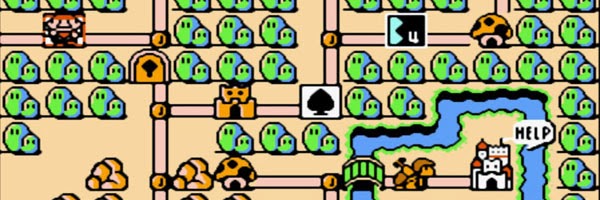
What really helps to bring out the greatness in Mario 3 though are the little touches on the world map screens. There are little mushroom huts where you can visit and collect new items, a sort of mushroom kingdom ‘snap’ game and wandering Kooper turtles which have to be dispatched one on one and it all adds to the feeling of fun and invention.  

Once you've made your way across the map screen to the castle of the land, you must board one of Bowser's Kooper kids ships, make your way through the treacherous maze of cannon balls and bullet bills before finally facing a showdown with whichever of the evil kids is at the helm. This is a truly epic and fitting end to each world that shows just how much attention to detail has been poured into the game. 

The difficulty pitch is just about perfect. Each world provides a gentle step up in difficulty from the last until you get to the absolute nightmare stages on the last world. What is so brilliant about the learning curve is that unless you use the warp whistles to move from one world to the next you don't really notice things getting harder. That's not to say the game seems easy, it just simply seems to match you move for move as you get more accustomed to it, a brilliant accomplishment. 

Overall, Mario 3 is practically perfect, and represents the pinnacle of NES platform games. In fact it still shows up a lot of far more graphically splendid games to this day. The only subsequent video games that really outshine Super Mario 3 are later releases in the Mario franchise. This is another example of gaming gold from yester year and one welcomed onto the virtual console services with open arms.

10/10

Monday, 16 December 2013

SteamWorld Dig Review (PC)


The notion of ‘digging’ has carved out a niche little sub-genre in recent times. We’ve had the indie juggernaut that is Minecraft, Super tough Spelunky and Terraria to name just a few. SteamWorld Dig  is, as the title suggests, another game that wants you to dig. However, it’s certainly doing it in its own way.

Playing as Rusty, a lone steamboat designed for digging, you find yourself exploring a post-apocalyptic world where humans seem to have disappeared. You arrive in the dustbowl town of Tumbleton after receiving the deed to your Uncle Joe’s mine. The town is home to a few remaining robotic inhabitants and it’s up to you to uncover the story of the mine and the towns folk.

Your initial forays into the mine will mainly be to find gold and gems which can then be traded and used to upgrade Rusty. All manner of items and upgrades are available and they continually expand as you find more money to spend. Along with this you will gradually uncover more abilities that Rusty can use to help traverse the depths. There’s an element of Metroid to the character advancement but we wouldn’t go as far as to say that this is a Metroidvania.

The game world sets itself out into three main sections. You have the town where you can talk and upgrade, the main part of the mine and self-contained rooms within it. For a large amount of the game you’ll be continually digging downward in the main mine area. The goal here is to find cash, avoid critters and find rooms as you uncover the truth of what happened to the humans and the world. The deeper you go, the thicker the rock gets and the tougher the enemies become. Unless you keep upgrading it can be a tiresome task to break through the bedrock so you’ll need to be heading back to the surface to upgrade your pickaxe and other mining gear often.

This is perhaps one of the few flaws with the game. While there are a number of short cuts back to the surface, there really aren’t enough of them for it to stop the game from dragging and getting repetitive on occasion. It’s not so bad when going down the mine as you can normally drop down tunnels you’ve dug, but going back up can be tiresome. It’s not enough to take away from the experience in the long term and there are teleporters that can be purchased, but a few more short cuts really wouldn’t have gone a miss.

The self-contain rooms within the mine provide a mixture of both platforming and puzzle solving to negotiate. Plot related rooms lead to power ups and boss fights while other hidden areas generally contain precious gems. SteamWorld Dig really is a platformer at heart and these rooms allow for the developers to show off how they have mastered the form. You’ll need quick reflexes and a good understanding of how your powers work to succeed and the difficulty level is pitches just about perfect throughout. Each room and boss is challenging but you’ll always feel you know how you should be beating it - it’s just a case of mustering the skill to do it.

There’s something really compelling about the game and as you dig deeper (both literally and into the mystery), you’ll really want to know what’s going on. It’s the sort of game you’ll start playing for a few minutes and end up sticking with for hours. 

Moving from the 3DS eshop to the PC digital services was always going to be a tough jump but it’s one that SteamWorld Dig has made easily and it shows a skill and understanding by the development team rarely seen elsewhere. SteamWorld Dig may well have gone unnoticed by a lot of you, but we would really recommend checking it out. It’s no longer just one of the best 3DS eshop titles but one of the best digital games available right now and it offers a fun, challenging and fresh experience for gamers to test themselves with no matter the platform.

Overall 8/10

Monday, 28 October 2013

Shin Megami Tensei: Devil Summoner: Soul Hackers Review (3DS)


Wrtitten by Adam Gulliver

Playing Soul Hackers is like taking a virtual reality trip back to the late 90’s. Not just the gameplay, but also the story. Memories of all those movies dealing with computers, hacking and virtual reality written by people who had no idea what they were talking about came flooding back as soon as the game begins. This is not so much a bad thing though, as there’s nothing wrong with a bit of nostalgia when it’s this enjoyable.

Soul Hackers was originally released for the Saturn in 1997 which goes a long way in explaining the style and feel of the game. Graphically, aside from the addition of 3D (which adds nothing by the way) it feels very basic, with disappointingly no new graphical update that we can see. Travelling through the hi-tech Amami city is done with a dot on a map, the first person dungeons are very basic in design and the battle animations are almost non-existent. So in that sense it’s a shame more care wasn’t taken with bringing it to a new audience. That aside, play for long enough and there’s still something here that will suck you in.

This could possibly be the diverse cast of characters you’ll encounter or the dual worlds you’ll be exploring. Dual because not only is the reality of Amami City available to explore, but also the virtual reality world of Paradigm X. A sort of MMO which has become the new big thing. Of course, it turns out that all is not as it seems and Paradigm X becomes a central plot point as you progress through the story. The story, which while initially starting off slowly definitely hooked us, and made us put up with the experience of learning the many mechanics found within.

Soul Hackers definitely takes you back to a time before hand holding became the norm. Coming into this as your first Shin Megami Tensei can be a pretty daunting experience. Tutorials are nowhere to be found and it’s really up to the player to discover how to best approach the game. It isn’t long before you’re thrown straight into your first turn based battle and really it’s all down to experimentation, something we actually quite enjoyed. Letting the player figure things out for themselves is definitely something that’s been lost as games have evolved and Soul Hackers has shown that not telling the player exactly what to do can make the game a rewarding experience.

Those new to the SMT series may be a little baffled by the battle system as it is, at first, quite daunting with options layered on top of options that can overwhelm quite easily. With each turn based battle you have six spaces for humans and demons that you collect. At the start of each turn you make each characters selection, whether it be magic, attack, item etc. Then the battle commences until all turns are done, and repeat. What sets this game apart from other RPG’s is the use of the demons that you can have join your team. In order to convince them to join, you can use the Talk option at the start of each battle. Conversing with the demons will more often than not bring up multiple choice answers.

This is where it gets weird. Demons seem to have as many problems as humans, with them asking questions ranging from the meaning of life to favourite foods. It’s all a bit surreal. Answer the question correctly from the multiple choices you’re given and it could very well lead the demon to join your party. Answer incorrectly and it could lead them to attacking you or just leaving in a huff.

Believe it or not that’s just the basics; from here you need to build up the trust of your demons. Lose trust and the demons could very well ignore your commands and just do what the hell they please. Then there’s fusing, a mechanic those who are familiar with the SMT series will understand, and others will initially be confused by. Fusing demons together making newer, more powerful ones, a crucial element in order to progress through the harder dungeons.

The dungeons being one of the real stars of Soul Hackers. As already mentioned, dungeons are played out in a first person manner, navigating the corridors and running into random battles. Dungeons each have a different style to them and can consist of tricky puzzles tiered across multiple floors. Disappointingly though these, like much in the game, are very old fashioned, only being able to move in four directions as opposed to full 3D movement.

The first appearance of Soul Hackers outside of Japan is a most welcome one. It may not have had the graphical update some would’ve hoped for, but the story and characters are interesting enough that it will grab you till the end.

Overall 7/10

Monday, 14 October 2013

SteamWorld Dig: A Fistful of Dirt Review (3DS)


The notion of ‘digging’ has carved out a niche little sub-genre in recent times. We’ve had the indie juggernaut that is Minecraft, Super tough Spelunky and Terraria to name just a few. SteamWorld Dig  is, as the title suggests, another game that wants you to dig. However, it’s certainly doing it in its own way.

Playing as Rusty, a lone steamboat designed for digging, you find yourself exploring a post-apocalyptic world where humans seem to have disappeared. You arrive in the dustbowl town of Tumbleton after receiving the deed to your Uncle Joe’s mine. The town is home to a few remaining robotic inhabitants and it’s up to you to uncover the story of the mine and the towns folk.

Your initial forays into the mine will mainly be to find gold and gems which can then be traded and used to upgrade Rusty. All manner of items and upgrades are available and they continually expand as you find more money to spend. Along with this you will gradually uncover more abilities that Rusty can use to help traverse the depths. There’s an element of Metroid to the character advancement but we wouldn’t go as far as to say that this is a Metroidvania.

The game world sets itself out into three main sections. You have the town where you can talk and upgrade, the main part of the mine and self-contained rooms within it. For a large amount of the game you’ll be continually digging downward in the main mine area. The goal here is to find cash, avoid critters and find rooms as you uncover the truth of what happened to the humans and the world. The deeper you go, the thicker the rock gets and the tougher the enemies become. Unless you keep upgrading it can be a tiresome task to break through the bedrock so you’ll need to be heading back to the surface to upgrade your pickaxe and other mining gear often.

This is perhaps one of the few flaws with the game. While there are a number of short cuts back to the surface, there really aren’t enough of them for it to stop the game from dragging and getting repetitive on occasion. It’s not so bad when going down the mine as you can normally drop down tunnels you’ve dug, but going back up can be tiresome. It’s not enough to take away from the experience in the long term and there are teleporters that can be purchased, but a few more short cuts really wouldn’t have gone a miss.

The self-contain rooms within the mine provide a mixture of both platforming and puzzle solving to negotiate. Plot related rooms lead to power ups and boss fights while other hidden areas generally contain precious gems. SteamWorld Dig really is a platformer at heart and these rooms allow for the developers to show off how they have mastered the form. You’ll need quick reflexes and a good understanding of how your powers work to succeed and the difficulty level is pitches just about perfect throughout. Each room and boss is challenging but you’ll always feel you know how you should be beating it - it’s just a case of mustering the skill to do it.

There’s something really compelling about the game and as you dig deeper (both literally and into the mystery), you’ll really want to know what’s going on. It’s the sort of game you’ll start playing for a few minutes and end up sticking with until your 3DS starts telling you it needs to be charged. 

We can’t think of another eshop game which has had that effect on us and it shows a skill and understanding by the development team rarely seen elsewhere. SteamWorld Dig may well have gone unnoticed by a lot of you, but we would really recommend checking it out. It’s probably the best 3DS eshop title available right now and it offers a fun, challenging and fresh experience for gamers to test themselves with.

Overall 8/10

Wednesday, 25 September 2013

Etrian Odyssey 4: Legends of the Titan Review (3DS)


The idea of searching dungeons for treasure seems to be having a bit of a resurgence lately, with all sorts of brawlers, slashers and crawlers making their way to various systems. This is the first of the Etrian games to make it to 3DS but the series has been mining the vein of dungeon exploration for some time now. With an experienced and knowledgeable team working in a fairly niche area it was always likely this was going to turn out well, what is perhaps unexpected is how accessible this is for newcomers to the series.

In most JRPG’s the plot is one of two things and as we aren’t questing to save a princess it means it’s time to try and reach that good old life giving Yggdrasil tree. It’s all familiar hokum but there’s certainly a comfort to it in a game such as this. Aside from the story the style of game will be anything but familiar to many a modern gamer.

Etrian breaks itself into three main parts. To start with you have the town which is represented through a glorified menu screen. Different places allow you to save, get equipment, heal and get new quests. This is done via 2D art and speech bubbles and is both functional and very clearly explained. 

Your first task in town will be to set up your guild of adventurers. You have seven different classes to choose from and will then need to pick five heroes to arrange across the front and back row consisting of six spaces. Essentially you put fighters and shields at the front and medics and mages at the back but there are some cross-over characters to add variety. 

As the game progresses a ton of different skills are unlockable for each character and it leads to pleasingly deep amount of thought and strategy that can be applied to your team. Levelling up does not happen quickly and when you do you get a single skill point to add to your character. This means you need to choose the skills and magic they are going to use carefully. It also means that a certain amount of grinding is par for the course so take that as a warning before going in.

Once your team is set it’s time to venture into a dungeon. Here we have a mix of styles at work. The game is presented from a first person view as you walk around a grid based labyrinth. While doing this you’ll need to use the lower part of the 3DS screen to draw a map of where you are. The map drawing is easy and will soon become an obsession for the more OCD adventurers among us. There are also a host of handy symbols such as doors and water available just to drag and drop onto the grid styled area.

While dungeons are seen from the first person perspective this is not a real time combat game like Eye of the Beholder. Combat is initiated via random events in the same way as many an RPG and then plays out in the standard turn based fashion. There are large enemies that are visible in the game world who will chase you around but for the most part you have to rely on checking the handy danger meter to know when you’re about to be attacked.

Combat is tough and you’ll always have to have your wits about you to make it through a dungeon. If your party is wiped out its game over and you can normally only save in towns or at a portal. There are items that evacuate you from dungeons but they can only be used outside combat. For newcomers there is a casual difficulty setting which tones things down a bit, moves you back to town when you die and lets you set certain items to unlimited use. Even with these changes enemies present a danger, but careful progress can be made by all level of player.

The final part of the game takes place on a larger world map and has our heroes exploring the land in a blimp. Here you can search for treasure and recover food for the town. It also serves as your transport to new dungeons (although once a dungeon has been found it can be teleported to from the town). Even here you have to be careful as big monsters stalk the land looking for you. At least these are visible and there are no random battles while flying in the blimp.

Etrian Odyssey evokes memories of top down Amiga Dungeons and Dragons games, only played out in a new 3D landscape. There’s just something magical about it that allows you play it for long periods at a time. Drawing the map really works and all the system are near flawless. If ever there is a highly accessible hard core RPG then this is it. There really isn’t much we can fault with it and it achieves what it has set out to do excellently. If you’re not a fan of the genre then this may do little to change your mind but for those looking for some old school swords and sorcery style action we can’t think of anything to better it.

9/10

Monday, 15 July 2013

Four Weeks in Animal Crossing


 It's been another busy couple of weeks in the Animal Crossing Town of Retro101uk!

 The Dream Suite opened! (address 6900-2343-3782)

 Club LOL finally was completed.

 I got yet another badge!

 KK Slider rocked the place.

 We built a nice yellow bench.

 The bamboo flooring started to be layed.

We finished off with a few live classics from KK.

Saturday, 29 June 2013

Two weeks in Animal Crossing

Every now and then we will have a round up of what is going on in the village of Retro101. It won't be that often so if you aren't a fan of the charming Nintendo game then it'll be easy to ignore. It'll also be done in pictures for the most part. So then, let's get you up to date with the events of the first few weeks.

The Summer Solstice arrived, but we had no friends around to share this standee with :(

We caught our first shark!

The captain revealed a little too much information.

The swindling 'art' dealer arrived.

The camp site was opened and there was much rejoicing.

Thanks to a friend we made a killing on Turnips.

We even got a badge to celebrate.

The camel turned up and promply annoyed Tom Nook.

And finally. The fortune teller told us our fortune lay around the 'standard top'

Wednesday, 29 May 2013

The Legend of Zelda - Oracle of Seasons (Gameboy Colour)


One day our hero Link is drawn to the Triforce of Wisdom held within Hyrule castle. Suddenly it emits a blinding flash of light, Link  awakens in a forest in a far off land. The next thing he knows Onox, the General of Darkness, has swept away a young girl named Din, who just so happens to be the Oracle of Seasons. So yet again Link must save the day, how you ask? By searching dungeons of course!

Being linked with Oracle Ages Nintendo have licensed out the Zelda franchise to the masters of making almost identical games, Capcom. With much hesitation I approached the game fearing the magic of previous instalments would be lost. What I found however, was one of the most charming Zelda games of them all.

The idea of the game is to solve puzzles by changing the seasons. Need to get across a lake? Then change the season to winter and watch it freeze over. Or maybe the lake won’t freeze? Then change the season to summer and watch the water evaporate. A great idea that works brilliantly.

All the familiar Zelda elements are present; bombs, shield and boomerang to name just a few. Being a game about the seasons, unsurprisingly, nature is very important. Tying in with this theme it is possible to collect different types of magic seeds from trees, some cause fire while others act like the old Pegasus boots and give you a sudden burst of speed.

Dungeons wise the levels do not really offer anything dramatically different from what has gone before. However, that does not stop them from being as excellently designed as ever, with fiendish puzzles needing to be solved throughout. Unfortunately, it does share some of the faults of its predecessor Links Awakening. For instance the difficulty level is still set way too high from the start and a better learning curve for the sake of newcomers would have been nice. Also, some puzzles are as bizarre as ever which can lead to a lot of frustration. Saying this though they are only minor faults that only detract a little from the magic of the game.

Size wise, Oracle of Seasons is absolutely huge. As well as dungeons and overland areas the game is filled with little underground tunnels and even an entire subterranean civilisation that trades with their very own currency. A great achievement for the Gameboy Colour, something made all the more impressive when you consider the quality of graphics. Much improved from Links Awakening, everything is truly lovely. More importantly each of the four seasons is easily distinguishable from each other.

Overall, Oracle of Seasons is an absolute joy to play. So much magic has been put into the cartridge you feel it right from the start. This coupled with the fact that it includes a link up feature with Oracle of Ages where characters and items can be transferred across makes the game almost reach the dizzy heights of A Link to the Past. Unfortunately, the lack of a learning curve and a few obscure puzzles mean the game just falls short. A shame, but none the less Oracle of seasons is an exceptional game and one of the better Zelda adventures.

Overall 9/10

Wednesday, 1 May 2013

Luigi's Mansion 2: Dark Moon Review (3DS)


Anyone who owned a Gamecube will have fond memories of the original Luigi’s Mansion. The humour and clever game design created a charming and unique game full of character. Now Luigi is back on the 3DS in what is one of most anticipated games on the console. Was it worth the wait? Venture forth, torch in hand to find out. 

The game starts with our cowardly hero being summoned by Professor E.Gadd. The Dark Moon which keeps the ghosts under control have been shattered and they are now terrorising a number of old mansions and buildings. Along with your trusty converted vacuum cleaner it’s up to you to save the day.

Though similar looking, Luigi’s Mansion 2 has undergone quite a drastic change in terms of mechanics and level design. This is indeed a proper sequel rather than a rehash of the last game. The first thing you notice is the change in the enemies you come up against. The original game was mostly about finding a unique ghost in its room, then working out the puzzle of how to get it to reveal its heart with the torch so it could be captured.

Mansion 2 pretty much does away with this style of play completely. Now the ghosts are more generic and not tied in with the puzzles you come up against. There are also more of them at any given time. The game often becomes a series of locked arenas -  as you walk in the door locks and the mischievous ghosts appear. Once all the ghosts in a room have been dealt with the doors will open and allow you to continue.

While the ghosts are no longer individual they still contain all the humour of before. You start out coming up against standard green ghosts with new types being introduced regularly as you progress. Some of these are strong or super smart, while other will fling goo or leap out and scare you – causing you to drop your capture beam. Even the basic green ghosts change, not in look but they get more intelligent as you go on. This starts off with them wearing sun glasses to avoid your torch glare. From then on they will try anything to avoid being captured such as using shovels to hide behind or wearing buckets on their head that can’t be vacuumed off. 

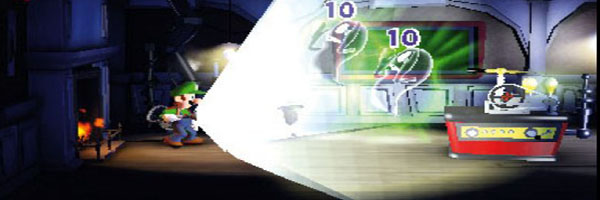
The capturing of ghosts has also changed. It is now much more about quick reactions and quickly flashing multiple ghosts with the torch at once. This then allows them to be sucked up. In the first game this was achieved like a mini fishing game while here it is about keeping in line with the ghost long enough and pulling in the opposite direction to fill a meter. Once full, pressing A will give a strong tug on the ghost and hopefully drag it into the vacuum. The changes work for the better and it turns the game into a much more action and score focused affair with bonus coins and gold bars given out for multiple captures at once.

Puzzles have changed as well. The game is now full of secrets and small puzzles which need to be navigated. Most puzzles are used to hide entrances and exits with the more complex ones hiding hidden gems and the elusive BOO’s that lurk around each stage. You are also given a dark light torch which is used to reveal things the ghosts have hidden. This creates a strange ‘spot the difference’ feeling as areas can have different things hidden depending on which mission you are doing. It works well and keeps you on the lookout for anything out of the ordinary.

Yet another change is the new mission structure. Instead of one big mansion to explore there are now five areas, each of which is set out in a number of missions. Once a mission is complete you are brought back to E.Gadd's lab. This change in structure has both good and bad points. On the down side, it feels frustrating not to be allowed to fully explore a whole level at a time and even makes the idea somewhat redundant as objects can move around depending on the mission. It can also be frustrating not being allowed to save in a mission as though they are meant to be fairly short, if you get stuck on a puzzle you could be wandering around for a very long time.

There are positives to the approach though. When the mission structure works it feels perfect for mobile play as you are doing bite sized chunks of the game. The different mansions and buildings are also very unique and full of clever design choices and fun things to see.  It also allows the game to be replayed as a score attack game with any mission re-playable to find extra gold or ghosts to capture. Either way it certainly doesn’t ruin the game, but it can’t be ignored when it impacts negatively on the experience either.

Level design is excellent throughout with literally every room filled with something to tinker around with. You’ll be using the vacuum to roll rugs up, spin ceiling fans and drag objects which opens all sorts of secret passages and routes through the game. Another great touch is that almost every time you come to a window or spy hole you can peak through to what the ghost are up to on the other side. Sometimes this starts a small cut scene while others it just allows you to see what type of ghost is floating around causing trouble. They are always worth checking and genuinely funny.

Graphically, the game might not be quite as sharp as we were hoping but it looks good enough and every area is unique and overflowing with character. The title also offers another example of the 3D effect working incredibly well. This is one of the few 3DS games where you will want to play every second of it with the 3D turned on full. The sound is equally full of character with playful effects mixing with the spooky theme tune. You’ll soon notice Luigi nervously singing along as he walks around, which is a nice touch.
 
Luigi’s Mansion 2 is a difficult game to nail down. It has faults relating to the structure of the game and ability to save and when they strike it can be very frustrating. But the feeling of frustration is uncommon and in the next minute something fun will have distracted you from it. When the games allowed to flow it shows itself as an undeniable classic, and it does flow well for very long periods.  The game also seems to improve as it goes on and it’s here the true magic at work comes into play. There's also a multi-player challenge tower which allow for ghost busting pals to team up and try and take on a number of time and score attack style missions.

Overall, there are some very good and fun ideas that work very well here. It’s a great progression in many ways from the original and at times it’s a truly sublime experience.  It’s also different enough from the first game for fans to want to own and enjoy both. It’s not perfect, but when it works (Which it does most of the time), there are few other games that bring such a smile to your face and it’s hard to argue against that.

8/10